If you searched for "speech impediment" tonight, you almost certainly have someone specific in mind. Yourself, or your child, or a parent whose speech has changed.
Here is the first thing worth knowing, and it saves a lot of wasted effort: "speech impediment" is not a diagnosis. It is an umbrella term. Underneath it sit at least six genuinely different conditions, with different causes, different prognoses, and treatments that have almost nothing in common.
Working out which one you are looking at is not a technicality. It is the whole game.
In short: a speech impediment is any condition that interferes with producing speech clearly or fluently. The main types are articulation and phonological disorders, stuttering, cluttering, dysarthria, apraxia of speech, and voice disorders. Two questions sort most of them: did it appear gradually or suddenly, and is the problem forming the sounds, or keeping speech flowing?
Speech impediment: the definition
A speech impediment - clinicians usually say speech disorder or speech sound disorder depending on the type - is any condition that interferes with producing speech that is clear, fluent, and comfortable to produce.
The distinction that matters most, and the one most often missed, is between speech and language:
Someone can have flawless language and impaired speech - rich vocabulary, perfect grammar, clear thinking, and words that will not come out cleanly. That is the most common situation by far, and it matters because it changes what help looks like. A person with a speech impediment does not need simpler ideas. They need the mechanics addressed.
The reverse also exists: clear speech in the service of disordered language, as in aphasia - or in telegraphic speech, where the grammar is stripped out while the sounds themselves are fine.
The six main types
1. Articulation and phonological disorders
The most common category, especially in children. Specific sounds are produced incorrectly, substituted, or omitted: a lisp on /s/, "wabbit" for "rabbit", "tar" for "car".
An articulation disorder is a motor problem - the tongue, lips, or jaw are not shaping the sound correctly. A phonological disorder is a pattern problem - the child has not sorted out the sound system, and simplifies whole classes of sounds at once.
The difference is practical. Articulation errors are worked sound by sound. Phonological errors are worked pattern by pattern, which is faster when the pattern is the problem.
2. Stuttering
Speech is interrupted rather than mis-formed: blocks where nothing comes out, repetitions of sounds or syllables, prolongations, usually with physical tension and often with anticipation - knowing a word is going to be hard before reaching it.
Stuttering is neurodevelopmental. It is not caused by nervousness, bad parenting, or trauma, and it is not a habit. Around 5 to 8% of children go through a period of stuttering; most recover, and roughly 1% of adults continue to stutter.
Two broad treatment families exist, and they aim at different things: fluency shaping changes how speech is produced to make it fluent, while stuttering modification changes how the person manages moments of stuttering. The comparison of fluency shaping and stuttering modification covers when each is the better bet.
3. Cluttering
The least recognised of the six, and the one most often mistaken for something else. Speech is too rapid or too irregular for the articulation and discourse planning to keep up: syllables collapse into each other, word endings drop, sentences restart, and the listener asks "what?" a lot.
The defining feature is that the speaker does not perceive their own rate in the moment. This is why "just slow down" produces about ten seconds of change and then nothing, and why families find it so frustrating.
Cluttering is routinely diagnosed as stuttering, ADHD-related, or nothing at all. The cluttering guide covers it properly, and cluttering vs stuttering covers the differential, which is the part clinicians most often get wrong.
4. Dysarthria
Here the cause is neurological. Damage or disease affecting the nerves and muscles of speech makes articulation weak, slow, imprecise, sometimes slurred, nasal, or monotone. The person knows exactly what they want to say; the motor execution fails.
Common causes: Parkinson's disease, stroke, multiple sclerosis, ALS, cerebral palsy, traumatic brain injury.
This is the category that requires medical assessment rather than speech practice as a first step - particularly when onset was sudden.
5. Apraxia of speech
Also neurological, but a planning problem rather than a strength problem. The muscles work; the brain cannot reliably sequence the movements. Speech is effortful and inconsistent - the same word comes out differently on successive attempts, and the person often knows it is wrong and gropes for the right shape.
It occurs in children (childhood apraxia of speech) and in adults after stroke or brain injury.
6. Voice disorders
The problem is in the sound source rather than the shaping: hoarseness, breathiness, a voice that fades, pitch that will not sit where it should. Causes range from vocal nodules and laryngitis to vocal fold paralysis, and to the reduced vocal loudness of Parkinson's disease, called hypophonia.
Swipe the table to see every column
| Type | What the listener notices | Typical onset |
|---|---|---|
| Articulation / phonological | Specific sounds wrong or missing | Childhood, gradual |
| Stuttering | Speech stops and restarts, visible tension | Ages 2-5, often gradual |
| Cluttering | Too fast, syllables collapse, thread wanders | Childhood, persists into adulthood |
| Dysarthria | Slurred, weak, slow, nasal, monotone | Any age; sudden or progressive |
| Apraxia | Effortful, inconsistent, groping attempts | Childhood, or sudden in adults |
| Voice disorder | Hoarse, breathy, too quiet, wrong pitch | Any age, often gradual |
Measure a speech rate in 2 minutes.
You read, then you talk. Free, no sign-up.
Test my speech rate for free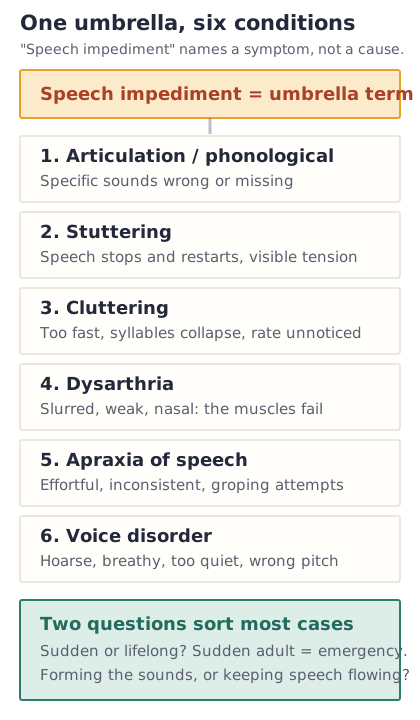
Two questions that sort most cases
Before looking for exercises, work out what you are dealing with. Two questions do most of the sorting.
Did it appear suddenly, or has it always been there?
Speech that deteriorates over hours or days - especially in an adult, especially alongside weakness, facial droop, or confusion - is a medical emergency, not a speech problem. Call emergency services. Speech that has been the same since childhood, or that has drifted over months and years, sits on a completely different timeline.
Is the problem forming the sounds, or keeping speech flowing?
"I cannot get the sounds right" points to articulation, apraxia, or dysarthria. "The sounds are fine but speech keeps stopping" points to stuttering. "Everything comes out at once and people cannot follow" points to cluttering or an excessive speaking rate.
These are three different mechanisms, and mixing them up is why so much self-directed practice goes nowhere. Working on articulation drills when the actual problem is rate produces a more effortful voice, not a clearer one.
What causes a speech impediment?
There is no single answer, which is why the umbrella term is unhelpful. The realistic list:
Two things that are not causes, despite being blamed constantly: anxiety and parenting. Anxiety makes an existing speech problem worse, sometimes dramatically. It does not create stuttering, cluttering, dysarthria, or apraxia. The distinction matters because treating a neurodevelopmental condition as an emotional one wastes years.
What actually helps
Treatment depends entirely on type, which is why the diagnosis comes first. Broadly:
For articulation and phonological disorders, speech therapy with a speech-language pathologist is the treatment, and it works well - particularly in childhood, where the evidence base is strongest.
For stuttering, the aim is rarely elimination in adults. It is reducing the frequency, duration, and physical effort of stuttering moments, and reducing avoidance - which is usually the part that has shrunk someone's life more than the stuttering itself.
For cluttering, the first lever is rate, and rate needs an external reference rather than willpower, precisely because self-perception is unreliable. That means visual feedback, a paced reading target, a measured number. How to talk slower covers the practical side, and speaking rate norms gives the reference values in syllables per second.
For dysarthria and apraxia, treatment is targeted motor work, and the underlying condition needs medical management alongside it. Progress is real but slower, and maintenance matters more than in the other categories.
For voice disorders, an ENT assessment comes first. Voice therapy on an untreated structural problem is wasted effort.
Not sure which of the six you are looking at? Tick what you observe and get the compatible conditions and the right professional.
When to see a professional
Three situations where waiting is the wrong call:
If you are not sure where you stand on rate specifically, the free voice test gives your speaking rate in syllables per second in about two minutes. It is a number rather than an impression - and since nobody perceives their own rate accurately, the number is worth more than the impression.
So what do I actually do
Four steps, in this order - the order is what most people get wrong.
FAQ - your questions about speech impediments
Is a speech impediment the same as a speech disorder?
Practically, yes - "speech impediment" is the everyday term and "speech disorder" the clinical one. Neither is a diagnosis on its own. Both are umbrella terms covering articulation and phonological disorders, stuttering, cluttering, dysarthria, apraxia of speech, and voice disorders.
Can adults fix a speech impediment?
It depends on the type, and "fix" is the wrong frame for some of them. Articulation errors often respond well at any age. Stuttering in adults is rarely eliminated, but its frequency, duration, physical effort, and - crucially - the avoidance built around it all change substantially with good therapy. Rate-driven problems like cluttering are among the most responsive, because rate is measurable and trainable.
What is the most common speech impediment?
Articulation and phonological disorders, by a wide margin, especially in children. Among adults, stuttering is the best known, while cluttering is probably the most common one that goes undiagnosed - it is routinely mistaken for stuttering, for ADHD, or for nothing at all.
Does anxiety cause speech impediments?
No. Anxiety makes an existing speech problem noticeably worse, sometimes dramatically, but it does not create stuttering, cluttering, dysarthria, or apraxia. The distinction matters because treating a neurodevelopmental condition as an emotional one costs years.
At what age should I worry about my child's speech?
There is no single threshold, and milestones vary widely. The practical markers: speech that unfamiliar adults find hard to understand at around age 4, any loss of skills the child previously had, or no progress over six months. Family members over-adapt without noticing, so "we understand her fine" is not strong evidence.
Key takeaways
"Speech impediment" names a symptom, not a cause. Six different conditions sit under it, and they do not share a treatment.
Two questions do most of the sorting: sudden or lifelong, and sound-formation or flow.
Sudden speech change in an adult is a medical emergency, not something to work on with exercises.
And for the rate-driven cases, the first move is not better articulation. It is slowing down - with an external reference, because the internal one is wrong.
General information only: it does not replace the advice of a speech-language pathologist or a doctor. Talk Slower is not a medical device.
Updated August 17, 2026

I cluttered all my life without knowing it. In 2022, a speech-language pathologist who specializes in fluency helped me understand and work on my speech rate. That journey is what led me to build Talk Slower, the tool I wish I'd had from the start.