Every fluency course teaches the dichotomy: fluency shaping rebuilds speech to prevent stuttering; stuttering modification changes how the person stutters. Every experienced clinician then spends a career blending them.
The dichotomy is still worth understanding precisely - because what you blend, and when, depends on it.
In short: neither approach dominates. Shaping wins on short-term fluency, modification wins on avoidance and quality of life, and relapse is the shared enemy of both. For adults, the useful question is almost never "which one?" but "in what order, and measured how?"
The variable both camps share is rate. Shaping controls it explicitly; modification needs it calm enough to execute techniques. Below is the syllables-per-second feedback clients watch while they practice - hit the mic button and try speaking fast, then deliberately slow.
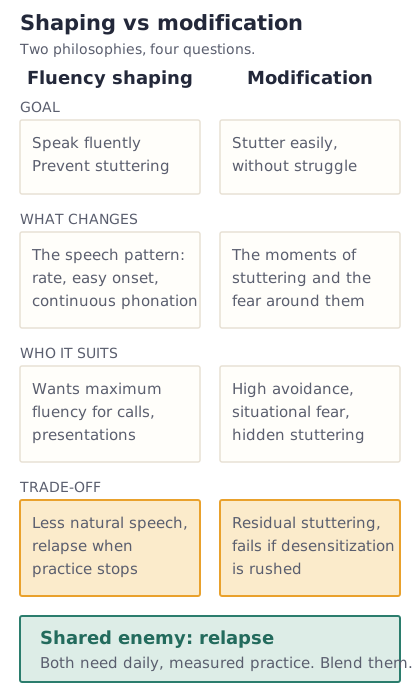
The two philosophies, side by side
Swipe the table to see every column
| Fluency shaping | Stuttering modification | |
|---|---|---|
| Goal | Speak fluently | Stutter easily, without struggle |
| Target | The speech pattern itself | The moments of stuttering + the fear around them |
| Core tools | Rate control, easy onset, continuous phonation | Identification, desensitization, cancellation/pull-out/prep set |
| Typical outcome | High fluency, risk of unnatural speech and relapse | More natural speech, residual stuttering without struggle |
| Fails when | Practice stops, speech sounds robotic, relapse shame | Desensitization is rushed, no practice structure |
| Feels like | Learning a new instrument | Exposure therapy for speech |
What the evidence supports
Three findings hold up across reviews:
In session: a practical decision guide
The honest answer to "which one?" is usually "in what order, and measured how?"
Run the decision guide on a real client. Six questions, then a recommended blend with the reasoning and the trade-off to discuss with them.
The shared infrastructure both approaches need
Strip the philosophy away and both camps need the same four things between sessions: a way for clients to practice daily, a way to know they're doing it right, a way to see it happened, and a graded path into real-world contexts.
That's the layer Talk Slower provides, whichever way you lean. Assign shaping drills (guided reading at a precise SPS target) or modification tasks (voluntary stuttering practice, easy-speech dialogues) from one dashboard. Clients practice in the browser with live rate biofeedback; you get adherence data, rate curves, and replayable recordings, remotely. The fading schedule from 2 SPS scaffolding back to natural speech stops being guesswork, because every session is measured.
Objective assessments. Visible home practice.
30-day free trial, no credit card. Always free for your clients.
Start the free 30-day trialFAQ - your questions about choosing an approach
Can I use fluency shaping and stuttering modification with the same client?
Yes - that's the contemporary default for adults. A common sequence: identification and desensitization first, then shaping tools for high-stakes contexts, with modification techniques as the fallback when a block happens anyway.
Which approach is better for children?
For preschoolers, neither label really applies - environmental and parent-led approaches dominate. For school-age children, blended programs with a strong desensitization component tend to serve awareness and teasing issues better than pure shaping.
Why do fluency shaping gains relapse?
Because the new pattern is effortful and the old one is automatic; under stress, automatic wins. Distributed daily practice with objective feedback, plus planned maintenance check-ins, is the only reliable counterweight.
What outcome measures should I track beyond percent syllables stuttered?
Speaking rate stability (SPS), avoidance and participation measures (e.g., OASES-type scales), self-rated struggle, and practice adherence. Fluency counts alone reward the wrong thing - tense fluency over easy communication.
Key takeaways
General information only: it does not replace the advice of a speech-language pathologist or a doctor. Talk Slower is not a medical device.
Updated August 16, 2026

I built Talk Slower after my own cluttering therapy. I wanted to create the tool my speech-language pathologist would have prescribed if it had existed: objective SPS measurement, at-home exercises, remote tracking. The app keeps evolving by staying close to speech-language pathologists.