Cluttering therapy has one central problem to solve: the client cannot hear their own speed. Self-monitoring is impaired - that's the disorder - so every instruction that begins with "notice when you speed up" quietly fails. Effective treatment routes around the broken monitor with external, real-time feedback, then rebuilds the internal one through repetition.
Here's a treatment plan built on that principle, activity by activity.
In short: the client cannot hear their own speed - that is the disorder, not a motivation problem. So every instruction starting with "notice when you speed up" fails by construction. Effective treatment routes around the broken monitor with external, real-time feedback, then rebuilds the internal one through repetition.
Start where assessment starts - microphone on. The module below is the app's mini rate assessment: a short read-aloud task returning syllables per second against Van Zaalen's norms. Baseline first; everything below is dosed against it.
The treatment logic
Assessment tells you which cluttering components dominate (see our full evaluation protocol): rapid/irregular rate, telescoped articulation, disorganized discourse, or all three. Therapy stacks accordingly:
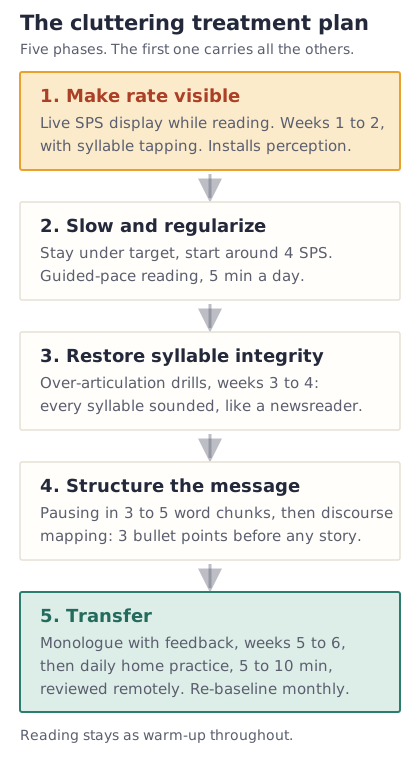
In session: core activities, with dosing
Swipe the table to see every column
| Activity | How | Dose |
|---|---|---|
| Rate biofeedback reading | Read with live SPS display, stay under target (start ~4 SPS) | 5 min/day |
| Guided-pace reading | Text scrolls at target rate, voice locks onto it | 5 min/day |
| Over-articulation drills | Exaggerated consonants, every syllable sounded - "speak like a newsreader" | 3–5 min/day |
| Syllable tapping | One finger tap per syllable while speaking | 2–3 min, early phase |
| Structured pausing | Read/speak in 3–5 word chunks, deliberate pause at each boundary | 5 min/day |
| Monologue with feedback | 1–2 min spontaneous speech watching the rate display, then replay | 3×/week |
| Discourse mapping | Plan-then-tell: 3 bullet points before any narrative | In session, then daily |
A 6-week starter progression: weeks 1–2, biofeedback reading + tapping (install perception); weeks 3–4, over-articulation + structured pausing (restore clarity); weeks 5–6, monologue work + discourse mapping (generalize), with reading maintained as warm-up.
Build the plan from your assessment. Tick the components you found and get the activities, doses and the measure to track, phase by phase.
Why biofeedback is the backbone
Telling a person who clutters to slow down is like asking someone to drive 55 with a broken speedometer. A live syllables-per-second display is the speedometer: the client sees the acceleration in the moment it happens and corrects on the spot. Repeated daily, the external gauge gradually recalibrates the internal one - clients start feeling the speed-up before the display shows it. That's the therapeutic endpoint.
This is the exact loop Talk Slower was built around (by a person who clutters, incidentally): live SPS biofeedback on every exercise, targets you set per client, and the whole activity table above available as assignable home practice.
The home practice loop
Cluttering gains decay fast without daily repetition - and cluttering clients, low on self-monitoring by definition, are the least able to self-verify their practice. The loop that works:
Clients never pay - your subscription (from $16.90/month, unlimited clients) covers them, and the Essential plan ($24.90/month, assessments included) amortizes on the first assessment of the month.
Objective assessments. Visible home practice.
30-day free trial, no credit card. Always free for your clients.
Start the free 30-day trialFAQ - your questions about cluttering therapy
What's the target speaking rate for cluttering therapy?
Anchor to norms: comfortable adult speech sits around 4–5 syllables per second, with cluttering-zone rates above ~5.5. Early therapy targets ~4 SPS with full articulation, then normalizes upward as control stabilizes. The number matters less than the client's ability to hold it.
How is cluttering therapy different from stuttering therapy?
Stuttering therapy manages involuntary blocks and the fear around them; cluttering therapy rebuilds rate regulation and clarity in a client who typically doesn't perceive the problem. Rate biofeedback is central for cluttering, optional for stuttering - and awareness work replaces desensitization. Co-occurring cases get both, sequenced.
Do pacing boards and metronomes work?
They install rhythm, and they have their place early on. Their limit: external rhythm doesn't train self-monitoring - the skill that must eventually carry natural speech. Feedback that shows the client their own rate transfers better than a beat they follow.
How long before results?
With daily practice, measurable rate control in structured tasks typically emerges within weeks; stable conversational carryover takes months. The single best predictor is practice adherence - which is why remote visibility on home practice is worth more than an extra weekly session.
Key takeaways
General information only: it does not replace the advice of a speech-language pathologist or a doctor. Talk Slower is not a medical device.
Updated August 16, 2026

I built Talk Slower after my own cluttering therapy. I wanted to create the tool my speech-language pathologist would have prescribed if it had existed: objective SPS measurement, at-home exercises, remote tracking. The app keeps evolving by staying close to speech-language pathologists.