Search "speech therapy app" and you get hundreds of results. Most are articulation drills, language games, or stuttering programs. Very few do the one thing a client who talks too fast actually needs: measure speech rate and give feedback on it in real time. If your caseload includes cluttering, tachylalia, or clients who outrun their own articulation, the generic app market has a gap.
In short: most speech therapy apps were built for articulation, language or stuttering, and they leave rate invisible - the one thing rate work needs. Six criteria separate the useful from the decorative, and the one that matters most is whether the tool works in conversation, not just in reading.
I am Clément, the founder of Talk Slower. I have cluttered since childhood. I spent years being told to "slow down" without any way to see whether I actually had. This guide is the buyer's guide I wish someone had handed my own SLP. It is honest about what to look for, where different categories of tools fall short, and where Talk Slower fits.
Want to see rate feedback before you read another word? Run a free, no-signup speech-rate test and watch your own SPS update live as you talk.
Why cluttering and fast speech need a specific kind of app
Cluttering is not an articulation error you can drill away, and it is not a language delay. St. Louis and Schulte (2011) describe its core as a rapid and/or irregular speech rate that degrades intelligibility. van Zaalen and Reichel (2015, 2019) push the point further: the central deficit in cluttering is impaired self-monitoring. People who clutter often cannot hear, in the moment, that they are going too fast. That is why "slow down" rarely sticks. The feedback loop is broken.
This is exactly where most speech therapy apps miss the target. An articulation app can tell a client whether they hit the /r/. A language app can score vocabulary. Neither one watches the clock. Rate is invisible to them. And rate is the whole game in cluttering.
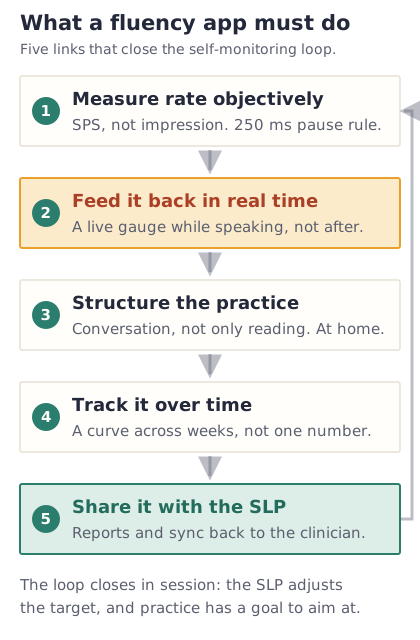
The intervention that the research keeps pointing back to is auditory and visual feedback that makes rate visible while the person is speaking. If a client can see their own pace climb, they can learn to bring it down, and over time they internalize the monitor they were missing. An app built for fluency and rate has to make that loop its first job, not an afterthought.
In session: the six things to look for
Use this as a checklist when you evaluate any tool, Talk Slower included.
Categories of tools and where they fall short
No single category does everything. Each has legitimate uses; the question is whether it fits cluttering and rate work specifically.
Swipe the table to see every column
| Tool category | Objective SPS rate | Real-time biofeedback | Works in conversation | At-home + clinician sync | Reports | Built for cluttering |
|---|---|---|---|---|---|---|
| Acoustic analysis software | Yes (manual) | No | Partial | No | Manual | No |
| Metronome / pacing apps | No | Partial | Yes | No | No | Partial |
| DAF apps | No | Yes (altered audio) | Yes | Partial | No | No |
| General speech-therapy apps | No | No | Partial | Partial | Partial | No |
| Stuttering-only apps | Partial | Partial | Partial | Partial | Partial | No |
| Talk Slower | Yes (automatic) | Yes | Yes | Yes | Yes | Yes |
A few honest notes. Acoustic analysis tools (general phonetics software) are precise and excellent for offline analysis, but they were built for researchers, not for a client practicing on the couch. Metronome and pacing apps genuinely help some clients find a slower rhythm, but they impose a beat rather than measure the client's own rate. DAF apps can produce striking in-the-moment effects for some speakers and have a real evidence base in stuttering, but they alter what you hear rather than show you your rate, and effects can fade. General speech-therapy apps are great for articulation and language but rarely touch rate. Stuttering-only apps are built around blocks and repetitions, a different problem from the runaway pace of cluttering (the distinction matters, see cluttering vs stuttering).
Because conversation is where carryover actually happens, the dialogue piece is worth seeing for yourself:
How Talk Slower works in practice
The setup is built around the clinician-client loop.
You create your account, add a client, and assign practice. The client opens Talk Slower in their browser, on a phone or a laptop, no install. As they talk, they see their SPS update live, with a target zone you can set based on their baseline and the rate norms. The goal is not to crawl, it is to land in a comfortable, intelligible range and learn to feel it.
Every session is logged. When the client comes back, they see their own curve. When you log in, you see the same curves across sessions, plus one-click reports you can export for notes, families, or progress reviews. The self-monitoring the research calls for happens at home, and the data that informs your clinical decisions comes back to you automatically.
Here is the live measurement module clients actually practice with:
Objective assessments. Visible home practice.
30-day free trial, no credit card. Always free for your clients.
Start the free 30-day trialHonest limitations
I would rather you trust this guide than oversell.
Talk Slower is browser-based software, not a medical device. It is not FDA-cleared, it does not diagnose, and it does not replace you. It is a practice and measurement tool that extends your clinical work between sessions. It assists self-monitoring; it does not make clinical decisions.
It is strongest for rate-driven presentations: cluttering, tachylalia, and fast or irregular speech. For stuttering, it can be a useful supportive tool, especially where rate control is part of the plan, but it is not a full stuttering-management program and it is not a substitute for therapy approaches built specifically around stuttering. If your client's primary need is block management or desensitization, Talk Slower plays a supporting role at most.
And like any feedback tool, it works when it gets used. The carryover still comes from your clinical skill and the client's practice. Talk Slower just makes the rate visible so that practice has something to aim at.
Getting started
Talk Slower is free to try for clinicians. You get a 30-day free trial, no credit card required. Your clients never pay, ever. When you move past the trial, pricing is a few dollars per client per month, billed to you, never to them.
The fastest way to judge it is to use it. Start a free SLP trial, add one client, and watch a single session. If the live SPS feedback does not earn its place in your toolkit within a week, you have lost nothing. You can also try the client experience yourself first with the free speech-rate test, and if you want technique ideas to share, see how to talk slower.
FAQ - your questions about choosing an app
Is Talk Slower a medical device or FDA-cleared?
No. It is browser-based practice and measurement software. It does not diagnose, it is not a medical device, and it complements rather than replaces your clinical work.
Does it replace speech therapy?
No. It is built to extend your work between sessions by giving clients live rate feedback at home and sending the data back to you. The clinical judgment stays with you.
What does it actually measure?
Speech rate in syllables per second (SPS), with words per minute available too. It uses the 250 ms pause rule (de Jong and Bosker, 2013) so articulation rate reflects how fast someone speaks while actually speaking.
Is it only for cluttering?
It is built first for cluttering, tachylalia, and fast or irregular speech. It can support stuttering work where rate control is part of the plan, but it is not a full stuttering-management program.
How much does it cost, and do my clients pay?
There is a 30-day free trial with no credit card. Clients never pay. After the trial, it is a few dollars per client per month, billed only to you.
Will my clients actually use it?
That is the whole design goal. It runs in the browser on a phone, starts in seconds, and shows feedback immediately, which is what keeps at-home practice from quietly dying.
Key takeaways
Further reading: learn the fundamentals in what cluttering is, and see how to structure an evaluation in our cluttering assessment guide.
General information only: it does not replace the advice of a speech-language pathologist or a doctor. Talk Slower is not a medical device.
Updated August 16, 2026

I built Talk Slower after my own cluttering therapy. I wanted to create the tool my speech-language pathologist would have prescribed if it had existed: objective SPS measurement, at-home exercises, remote tracking. The app keeps evolving by staying close to speech-language pathologists.