Cluttering is a fluency disorder in which speech comes out too fast, too irregular, or both, to the point that listeners struggle to follow. The words are usually there. The grammar is usually intact. But the delivery races, syllables collapse into each other, and pauses land in the wrong places. The result sounds rushed, jumbled, and hard to track.
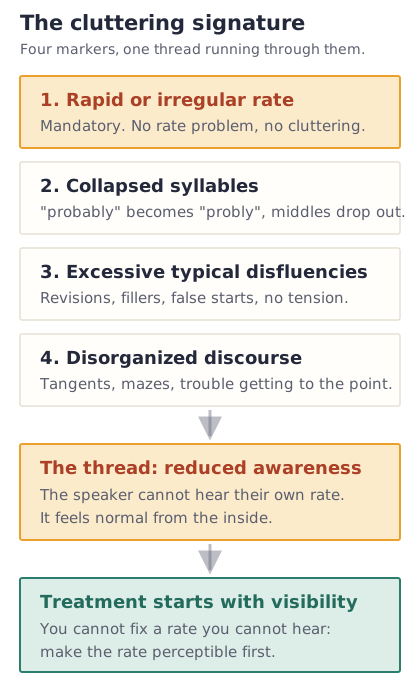
In short: cluttering is defined by a rapid or irregular rate, collapsed syllables and pauses in the wrong places - but its defining feature is that the speaker cannot hear their own rate. That is why it is missed so often, and why treatment starts by making rate visible rather than by asking anyone to notice it.
The reason cluttering is so often missed is simple and important: the person who clutters frequently does not hear their own rate. This is the heart of the disorder. It is not that they choose to speak fast or do not care. Their internal monitoring of how they sound is unreliable, so the runaway speed feels normal from the inside. A teacher, a partner, or a clinician notices the problem long before the speaker does. That monitoring gap is also why awareness building and feedback sit at the center of treatment.
Curious where your own rate lands right now? Take the free speech-rate test. You read a short text, then you speak freely, and you see your syllables per second on screen.
What is cluttering?
Cluttering is recognized as a fluency disorder, alongside stuttering, and it appears in clinical classification systems under the broader category of speech and language fluency problems. The most widely used working definition comes from St. Louis and Schulte (2011), often called the Lowest Common Denominator definition.
In that model, the mandatory feature of cluttering is a speech rate that is perceived as too rapid, too irregular, or both. On top of that core, clinicians commonly observe one or more of the following: an excessive number of typical disfluencies (revisions, interjections, and word or phrase repetitions rather than the tense blocks seen in stuttering), a breakdown in articulation or phonology so that syllables get telescoped or omitted, and pauses that fall in places that do not match the grammar of the sentence.
The practical takeaway is that rate is the entry point. If rate is not disturbed, it is not cluttering. The other features cluster around that disturbed rate and vary from one speaker to the next. The ASHA practice portal treats cluttering as a distinct fluency disorder that warrants its own assessment and management, while acknowledging it is under-recognized in everyday practice. Cluttering is sometimes described informally as a fast speech disorder, and the older term tachylalia points to the same rapid-rate core.
Cluttering symptoms
Cluttering presents differently across speakers, but the recurring signs are consistent enough to screen for. Look for:
Cluttering vs stuttering
Cluttering and stuttering are both fluency disorders, and they frequently co-occur, which is part of why cluttering gets overlooked. But the underlying experience is different.
Swipe the table to see every column
| Feature | Cluttering | Stuttering |
|---|---|---|
| Core problem | Rate and clarity of delivery | Involuntary disruptions to flow |
| Typical disfluencies | Revisions, fillers, whole-word repetitions | Blocks, prolongations, part-word repetitions |
| Physical tension | Usually low | Often present, sometimes marked |
| Awareness | Often low | Usually high |
| Effect of slowing down | Speech often improves noticeably | Slowing helps but the core blocks remain |
This is a compressed view. For a fuller breakdown, including mixed presentations, see our dedicated article on cluttering vs stuttering.
Could it be cluttering? Rate the markers above for yourself or someone you know and see where the pattern points. Indicative, not a diagnosis.
What causes cluttering
The honest answer is that the cause is not fully settled, but the evidence points toward how the brain plans, regulates, and monitors speech rather than toward anything emotional or motivational.
Cluttering is best understood as a difficulty with self-monitoring and rate regulation. The speech-motor and language-planning systems run ahead of the speaker's ability to track and adjust output in real time. Researchers working on cluttering assessment, including van Zaalen and Reichel (2015, 2019), frame impaired self-monitoring as central, which is why their work emphasizes auditory and visual feedback as a route back to control. Executive function also appears to play a role, and cluttering frequently co-occurs with ADHD. Prevalence estimates vary and good population data are scarce, so these associations should be held cautiously rather than stated as fixed rates.
What cluttering is not is just as important for clinicians and clients to hear. It is not nervousness. It is not laziness or low effort. It is not a sign that someone has not thought about what they want to say. People who clutter are often articulate and quick-thinking. The bottleneck is in monitoring and regulating the delivery, not in the ideas. Telling someone to "just slow down" rarely works for long, because they cannot reliably hear when they have sped back up. That is the regulation gap, and it is exactly what feedback-based therapy targets.
How cluttering is assessed
Good cluttering assessment is built on measured rate, not impression alone. Two settings matter, because they often diverge:
Rate is the core measure. Talk Slower uses SPS (syllables per second), which generalizes cleanly across languages and avoids the distortions of word length. For readers who think in words per minute, a rough conversion is one syllable per second to roughly 60 to 80 WPM, depending on the words. As a reference point, Jacewicz and colleagues (2009) reported English adult reading around 3.4 syllables per second and conversation around 5.1 syllables per second. Norms like these give you a yardstick rather than a hard cutoff; see our overview of normal speech rate norms.
A second measurement detail matters: articulation rate (rate during actual speech) should be separated from overall speaking rate that includes pauses. Following de Jong and Bosker (2013), pauses longer than about 250 milliseconds are excluded so that articulation rate reflects how fast the speech itself is produced. This distinction is what lets you see the bursts of speed that characterize cluttering even when overall rate looks average.
For screening, the Predictive Cluttering Inventory from Daly and Cantrell (2006) is a useful structured checklist. Treat it as a preliminary tool that supports clinical judgment, not as a fully validated diagnostic instrument. For a step-by-step protocol, see how to assess cluttering.
You can capture both reading and spontaneous samples and read the live numbers right here:
In session: what treatment looks like
If you take one principle from this article, take this: you cannot fix a rate you cannot hear. Because the defining feature of cluttering is impaired self-monitoring, the central job of therapy is to make rate perceptible. Once the speaker can see and hear what their delivery is actually doing, they can begin to regulate it. This is the rationale behind real-time biofeedback, and it lines up with the feedback-centered approach in the van Zaalen and Reichel work.
From that foundation, effective cluttering treatment tends to combine:
Objective assessments. Visible home practice.
30-day free trial, no credit card. Always free for your clients.
Start the free 30-day trialThe thread running through all of it is feedback plus repetition. Slowing down is easy for a minute. Hearing yourself reliably, day after day, until a sustainable rate becomes automatic, is the real work. If you want a practical primer to share with clients, our guide on how to talk slower walks through the same ideas in plain language.
For SLPs: using Talk Slower in your caseload
Talk Slower was built by Clément, who has cluttered since childhood. He built the tool he wished he had had. Here is how it fits a clinical caseload.
You get objective SPS tracking across reading and spontaneous samples, so progress is a number and a curve rather than a memory of how a session felt. Clients practice at home between sessions, with the same live feedback they get in your room, which is where most of the regulation gains are actually consolidated. And you get one-click reports, so documenting rate change over time takes seconds.
The model is designed to be easy to adopt. There is a 30-day free trial, no credit card, and it is free for your clients. For you it runs a few dollars per client per month. If you want to try it with a caseload, start a free SLP trial. If you are comparing options first, here is our take on choosing a speech therapy app for cluttering.
FAQ - your questions about cluttering
Is cluttering the same as stuttering?
No. Both are fluency disorders and they often co-occur, but cluttering is a problem of rapid or irregular rate and clarity with usually low awareness, while stuttering involves involuntary blocks and repetitions usually with high awareness and physical tension.
What causes cluttering?
The evidence points to difficulties with self-monitoring, rate regulation, and executive function rather than nervousness or low effort. It frequently co-occurs with ADHD, though prevalence estimates vary and should be read cautiously.
Can cluttering be treated?
Yes. The core principle is making rate perceptible through real-time feedback, then building a slowed but natural rate, over-articulation, purposeful pausing, and discourse practice through short, frequent sessions.
Why do people who clutter not notice they are doing it?
Cluttering involves impaired self-monitoring, so the speaker's sense of their own rate is unreliable. The fast, jumbled delivery feels normal from the inside, which is why external feedback is so useful.
How is speaking rate measured?
Talk Slower measures SPS (syllables per second). Articulation rate excludes pauses longer than about 250 milliseconds, following de Jong and Bosker (2013), so you can see the true speed of the speech itself, separate from pausing.
Is there a quick way to check my rate?
Yes. The free speech-rate test gives you your syllables per second after two short recordings, a reading and some free speech, no account needed.
Key takeaways
Further reading: cluttering vs stuttering, how to assess cluttering, where cluttering sits among the types of speech impediment, and why fast speech is often mistaken for tangential speech.
General information only: it does not replace the advice of a speech-language pathologist or a doctor. Talk Slower is not a medical device.
Updated August 16, 2026

I built Talk Slower after my own cluttering therapy. I wanted to create the tool my speech-language pathologist would have prescribed if it had existed: objective SPS measurement, at-home exercises, remote tracking. The app keeps evolving by staying close to speech-language pathologists.