You ask a simple question. Two minutes later you have heard about a neighbour, a car, and a holiday in 2011, and your question has not been answered. It was not evasion, and nothing said was untrue. The conversation simply left the road and never came back.
That is tangential speech, and the term is more precise than it sounds.
In short: tangential speech drifts progressively away from the topic and never returns to answer the original point. That last part is what distinguishes it from circumstantial speech, which wanders but eventually arrives. It is a clinical sign, not a diagnosis, and it appears in psychiatric conditions, dementia, brain injury, ADHD - and sometimes in nothing more than a very fast speaker whose planning cannot keep up.
What tangential speech means
Tangential speech - or tangentiality - is speech that moves away from the subject at hand by a chain of loosely related associations, and does not come back to the point. Each step is understandable in relation to the previous one; the destination has nothing to do with the question.
The image behind the word is geometric: a tangent touches a circle at one point and then heads off in its own direction.
Clinically it is described as a formal thought disorder - a disturbance in the organisation of thought as revealed through speech, rather than in the content of what is believed. The speech is the window; the organisation is what is being observed.
Two clarifications, because both are commonly misunderstood:
Examples
Concrete examples make the distinction much clearer than definitions do.
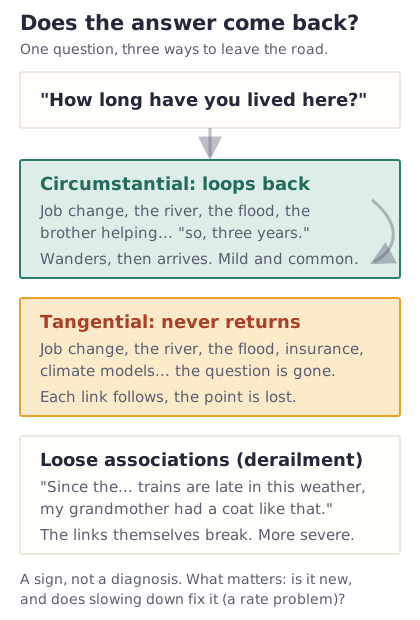
Question: "How long have you been living in this apartment?"
Tangential answer: "Well, I moved in after the job change, and that job was near the river, which flooded in the spring - my brother works in flood insurance, and he says the whole industry is changing because of the new climate models, which honestly I do not think anyone understands properly."
Notice the structure. Every link is followable. The question about duration of residence is never answered, and there is no attempt to return to it.
The same question, answered circumstantially: "Well, I moved in after the job change - that was the job near the river, which flooded that spring, so it was a chaotic time, my brother was helping me move - anyway, that was three years ago in March, so three years."
Same wandering. It arrives. That is circumstantial speech, and it is far more benign.
And derailment: "I have been here since the - the trains are always late in this weather, my grandmother had a coat like that."
Here the links themselves break down. Successive statements have no discernible relationship. That is a more severe pattern than tangentiality.
The four neighbours, and how to tell them apart
This is where most confusion lives, and getting it right changes what the observation means.
Swipe the table to see every column
| Pattern | What happens | Does it return to the point? | Severity |
|---|---|---|---|
| Circumstantial speech | Excessive detail and digression | Yes, eventually | Mild |
| Tangential speech | Drifts off by loose associations | No | Moderate |
| Derailment | Links between ideas break down | No, and connections are unclear | More severe |
| Flight of ideas | Rapid jumps, driven, pressured | No, and speech is hard to interrupt | Suggests mania |
| Word salad | Words without discernible structure | No | Severe |
The two most useful discriminators:
Does it come back? Circumstantial versus tangential turns entirely on this. It is a genuinely useful question to ask yourself in a conversation.
Is it fast and driven? Flight of ideas travels with speed, urgency, and difficulty interrupting - the same cluster as pressured speech. Tangential speech can occur at an entirely normal, unhurried rate.
What causes tangential speech
Tangentiality appears across a wide range of situations, which is exactly why it means little in isolation.
The pattern that should prompt professional assessment is a change: someone whose speech has become disorganised, who did not use to be like this, particularly alongside changes in mood, sleep, memory, or functioning.
Measure a speech rate in 2 minutes.
You read, then you talk. Free, no sign-up.
Test my speech rate for freeThe part that is often missed: when disorganised speech is a rate problem
Here is a distinction that gets overlooked, and it matters because it points somewhere completely different.
Speech can appear disorganised for a reason that has nothing to do with disordered thought: the speaker is going faster than their own discourse planning can keep up with.
This is the core of cluttering, a fluency disorder. The rate outruns the planning, and the result looks strikingly like tangentiality from the outside: sentences that restart, propositions abandoned halfway, revisions, filler words, a listener who cannot follow the thread. Ask a clarifying question and the answer is usually perfectly coherent - the thinking was fine, the delivery was not.
Four features separate cluttering from tangentiality:
That last point is the practical one. If the disorganisation has been there since childhood, gets worse when the person is excited or rushed, and improves when they slow down, the question to pursue is fluency and rate - not thought disorder. What is cluttering and cluttering vs stuttering cover this properly, and the free voice test will tell you in about two minutes whether the rate is actually elevated, which is the fastest way to find out.
What helps
It depends entirely on the cause, which is the recurring theme of this whole family of terms.
Where tangentiality reflects a psychiatric or neurological condition, the treatment is treatment of that condition. Speech organisation improves as the underlying state improves; working on the speech in isolation does very little.
Where it reflects executive difficulty - ADHD, brain injury - practical structure helps: one question at a time, written prompts, an agreed signal to bring the conversation back, planning the shape of an answer before starting.
Where it is a rate and fluency problem, the levers are the ones that work for cluttering: reducing rate with an external reference rather than willpower, deliberate pausing at sentence boundaries, and explicitly planning discourse structure before speaking. How to talk slower covers the method.
If you are the listener, three things reliably help: ask one question at a time, repeat the question calmly when the answer drifts rather than letting it run, and resist finishing sentences. None of these are cures. All of them make conversations work better.
Test your ear: six answers to one question, label each one and get the rule behind it.
So what do I actually do
Whether you are the listener or the person being described, the first move is the same: work out which pattern you are looking at.
FAQ - your questions about tangential speech
What is the difference between tangential and circumstantial speech?
Circumstantial speech wanders through excessive detail but eventually answers the question. Tangential speech drifts away by loose associations and never returns to the point. Circumstantiality is mild and extremely common; tangentiality is considered more significant.
Is tangential speech a sign of schizophrenia?
It can be, as one feature of formal thought disorder, but it is not specific to schizophrenia at all. It also appears in mania, dementia, brain injury, ADHD, autism, and in anyone who is tired, stressed, or intoxicated. On its own it is not diagnostic of anything.
What is the difference between tangentiality and derailment?
In tangentiality, each link is followable - you can trace how the speaker got from the question to the holiday in 2011. In derailment, the links themselves break down: successive statements have no discernible relationship. Derailment is the more severe pattern.
Can ADHD cause tangential speech?
People with ADHD often go off on tangents, interrupt, and lose the thread of turn-taking. The pattern is usually lifelong and situational rather than a change in state, and it typically corrects when the person is reminded of the original question - which is a useful practical difference.
My speech gets disorganised when I am excited. Is that tangentiality?
Probably not. If it happens when you speed up, if slowing down fixes it, and if it has been that way since childhood, the more likely explanation is that your rate is outrunning your discourse planning - the core of cluttering. That is a fluency question, and the fastest way to check it is to measure your speaking rate.
Key takeaways
Tangential speech drifts and never returns. Circumstantial speech drifts and arrives. That single question does most of the diagnostic work.
It is a sign, not a diagnosis, and it appears in everything from psychosis to fatigue. What matters is whether it represents a change.
Fast and hard to interrupt points elsewhere - towards flight of ideas and pressured speech.
And disorganised speech is not always disorganised thought. When the rate is high, when slowing down fixes it, and when it has been lifelong, the question is fluency - not thought disorder.
This article is general information, not medical advice. If someone's speech has become disorganised, or you are concerned about a change, speak to a doctor.
- Pressured speech: what it means
- Speech impediment: types and causes
- What is cluttering?
- Free voice test
General information only: it does not replace the advice of a speech-language pathologist or a doctor. Talk Slower is not a medical device.
Updated August 17, 2026

I cluttered all my life without knowing it. In 2022, a speech-language pathologist who specializes in fluency helped me understand and work on my speech rate. That journey is what led me to build Talk Slower, the tool I wish I'd had from the start.