"Mummy shoe." "Daddy go car." "More juice."
If you are the parent of a two-year-old, this is the sound of your house right now, and it is called telegraphic speech. It is entirely normal and, in a toddler, a sign that language is developing on schedule.
But the same term is also used for something quite different: the speech of an adult after a stroke. Same label, opposite implications - one is a developmental milestone, the other is a symptom.
Sorting out which one you are reading about is the single most useful thing this article can do.
In short: telegraphic speech is speech stripped down to content words, with the small grammatical words left out - like an old telegram, where every word cost money. In toddlers it is a normal stage around 18 to 30 months. In adults the same pattern is called agrammatism and typically follows brain injury, most often Broca's aphasia. Context decides everything.
Telegraphic speech: the definition
Telegraphic speech is speech that keeps the content words - nouns, verbs, adjectives - and omits the grammatical ones: articles, prepositions, auxiliary verbs, and inflections.
"The dog is sitting on the chair" becomes "dog sit chair."
The name comes from telegrams, which were charged by the word, so senders stripped messages down to what carried meaning: ARRIVING TUESDAY SEND CAR. What survives is the meaning; what disappears is the grammatical scaffolding.
The linguistic terms for the two categories are useful here: content words (also called open-class) carry meaning, and function words (closed-class) carry grammatical relations. Telegraphic speech preserves the first and drops the second.
Meaning one: a normal stage in toddler language
In typical language development, telegraphic speech is a stage, not a problem. The rough sequence:
Swipe the table to see every column
| Age | Stage | Example |
|---|---|---|
| ~12 months | Single words (holophrases) | "Milk" |
| ~18-24 months | Two-word combinations | "More milk", "Daddy go" |
| ~24-30 months | Telegraphic speech, 3+ words | "Mummy give me milk" |
| ~30-36 months | Function words appear | "Mummy is giving me the milk" |
What is happening is not laziness or imitation of adult shorthand. The child is prioritising: with limited capacity for sentence planning and production, the words that carry meaning come first, and the grammatical machinery is added as capacity grows.
Two useful observations for parents:
The grammar is already there before it is spoken. Toddlers in the telegraphic stage typically understand function words well before producing them. Comprehension leads production, generally by a wide margin.
It resolves without teaching. Function words appear gradually through ordinary interaction. The thing that helps is not drilling but expansion: the child says "dog sit", and you reply "yes, the dog is sitting down" - reflecting back a slightly fuller version rather than correcting. Recasting like this is well supported and requires no programme.
Meaning two: agrammatism in adults
The same surface pattern in an adult means something else entirely, and clinicians usually call it agrammatism rather than telegraphic speech to keep them apart.
It appears most characteristically in Broca's aphasia, which follows damage to the left frontal language areas - usually a stroke, sometimes traumatic injury or a tumour. Speech becomes effortful, halting, and reduced to content words: "walk... dog... park", produced with visible effort and often with the person acutely aware that it is coming out wrong.
That awareness is the cruel part, and it is diagnostically important. In Broca's aphasia comprehension is relatively preserved, so the person generally understands what is being said to them and knows their own output is not what they intended. This differs sharply from Wernicke's aphasia, where speech is fluent and grammatically shaped but empty of meaning, and awareness is often reduced.
Agrammatism also appears in primary progressive aphasia, where the onset is gradual rather than sudden - which matters, because a gradual onset changes the diagnostic path entirely.
Swipe the table to see every column
| Toddler telegraphic speech | Adult agrammatism | |
|---|---|---|
| Age | Roughly 18-30 months | Any adult age |
| Onset | Developmental, expected | Sudden (stroke) or progressive |
| Effort | Speech is easy, fluent for its length | Effortful, halting, visibly hard |
| Awareness | None - nothing feels wrong | Usually acute and frustrating |
| Direction | Improving week by week | Static or worsening without treatment |
| Meaning | A milestone | A symptom needing assessment |
Sudden onset of this pattern in an adult is a medical emergency. New difficulty producing speech, especially with weakness or facial droop, means calling emergency services immediately. Stroke treatment is time-critical, and hours matter.
Measure a speech rate in 2 minutes.
You read, then you talk. Free, no sign-up.
Test my speech rate for free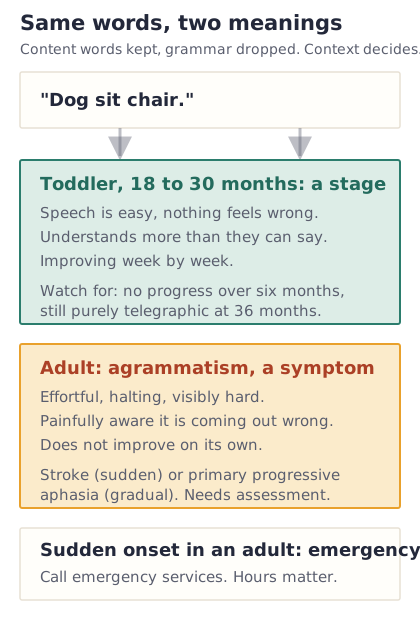
When a toddler's telegraphic speech is worth checking
Since the stage is normal, the useful question is when it is not resolving as expected. Speech and language milestones vary a great deal between children, so no single marker is decisive - but these are worth raising with a doctor or a speech-language pathologist:
One point worth stating plainly, because it drives a lot of unnecessary anxiety: being a late talker and having a language disorder are not the same thing, and most late talkers catch up. Assessment is not a diagnosis - it is how you find out which situation you are in, and it costs very little compared with waiting.
Who is speaking, how it started, what else you notice: get an indicative verdict in three clicks.
Telegraphic speech is about language, not speech clarity
A distinction worth holding onto, because it determines what kind of help is relevant.
Telegraphic speech is a language pattern - it concerns grammar and sentence structure, what is being constructed.
Speech disorders concern production - how sounds and flow are produced. A child who says "dog sit chair" has a language pattern. A child who says "dod thit thair" has a speech sound issue. A child who blocks and repeats has a fluency disorder. These are genuinely different, and the overview of speech impediment types lays out the whole map.
They can coexist, and often do. But treating one when the other is the problem is how families lose a year.
So what do I actually do
If you are a parent, the answer is reassuring and short.
FAQ - your questions about telegraphic speech
At what age is telegraphic speech normal?
Roughly 18 to 30 months, following two-word combinations and preceding the appearance of function words. Milestones vary widely between children, so the pattern matters less than the direction of travel: function words should be starting to appear by around three years.
Is telegraphic speech a sign of autism?
Not on its own. It is a normal developmental stage, and short utterances alone say very little. What is worth attention is the wider picture - comprehension, social interaction, play, eye contact, and any loss of skills the child previously had.
What is the difference between telegraphic speech and agrammatism?
They describe the same surface pattern in opposite contexts. In a toddler it is a developmental stage: speech is easy, the child is unaware anything is missing, and it improves week by week. In an adult it is agrammatism, usually after a stroke: speech is effortful, the person is acutely aware it is wrong, and it does not improve on its own.
Should I correct my toddler's telegraphic speech?
No. Correcting creates worry where there was none. Expansion works better and takes no extra effort: repeat what they said in a slightly fuller form and carry on with the conversation.
My three-year-old still speaks in three-word sentences. Should I be concerned?
It is worth raising with a doctor or a speech-language pathologist - not as an emergency, but because assessment is how you find out which situation you are in. Most late talkers catch up, and being a late talker is not the same as having a language disorder. Waiting six more months to find out is the only genuinely costly option.
Key takeaways
Telegraphic speech keeps the meaning and drops the grammar - content words in, function words out.
In toddlers it is a normal stage at roughly 18 to 30 months, and it resolves through ordinary interaction. Expanding what the child says works better than correcting it.
In adults the same pattern is agrammatism, usually from stroke, and sudden onset is an emergency.
The differentiators are effort and direction: a toddler produces short sentences easily and improves week by week; an adult with agrammatism struggles visibly and does not spontaneously improve.
This article is general information, not medical advice. If you have concerns about a child's language development, or about sudden speech change in an adult, speak to a professional - urgently in the case of sudden change.
General information only: it does not replace the advice of a speech-language pathologist or a doctor. Talk Slower is not a medical device.
Updated August 17, 2026

I cluttered all my life without knowing it. In 2022, a speech-language pathologist who specializes in fluency helped me understand and work on my speech rate. That journey is what led me to build Talk Slower, the tool I wish I'd had from the start.