Someone is talking, and you cannot get in. Not because they are rude - because there is no gap. The speech comes in a continuous stream, loud, urgent, jumping between topics, and any attempt to interject slides off.
If you have watched that happen to someone you care about, or been told you do it, "pressured speech" is the term you are looking for. It is worth understanding precisely, because unlike simply talking fast, it usually points to something specific - and often something treatable.
In short: pressured speech is rapid, driven speech that is difficult to interrupt and feels compelled rather than chosen. It is a clinical sign rather than a diagnosis, most classically associated with mania and hypomania, but also seen in anxiety, stimulant use, and some medical conditions. The urgency-to-interrupt quality is what separates it from a naturally fast speaking rate.
What pressured speech means
Pressured speech describes speech that is rapid, often loud, and produced with a sense of urgency or compulsion - as though the person cannot easily stop. Clinicians look for a specific quality: it is hard to interrupt. Attempts to break in are talked over or ignored, not out of hostility, but because the flow does not have gaps to break into.
The term comes from psychiatric examination, where speech is described along several dimensions: rate, volume, quantity, and the ease with which it can be interrupted. Pressured speech is the combination of high rate, high quantity, and low interruptibility.
Two things it is not:
Pressured speech vs simply talking fast
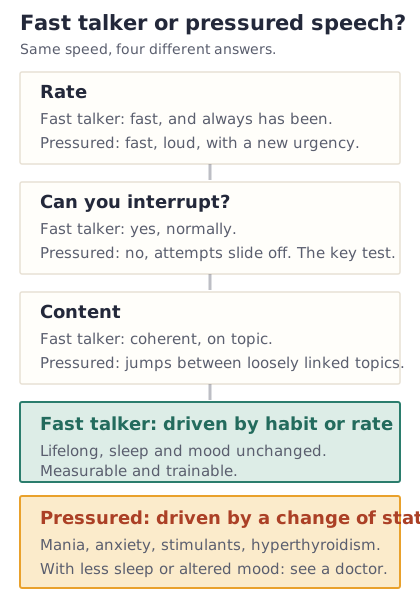
This distinction is the practical heart of the matter, because the two lead to entirely different places.
Swipe the table to see every column
| Fast speaking rate | Pressured speech | |
|---|---|---|
| Can they be interrupted? | Yes, normally | Not easily - attempts slide off |
| Does it feel chosen? | Yes, it is just how they talk | No, it feels driven or compelled |
| Is it new? | Usually lifelong | Usually a change from baseline |
| Sleep, energy, mood | Unchanged | Often changed alongside |
| Content | Coherent, on topic | Often jumps between loosely linked topics |
| What it points to | Rate, habit, sometimes cluttering | An underlying state worth assessing |
The single most useful question is "is this new?" A person who has spoken quickly since childhood, whose sleep and mood are unchanged, and who can be interrupted normally, does not have pressured speech. They have a fast speaking rate - which can absolutely be a problem in its own right, and is a very different problem.
A person whose speech has become rapid and hard to interrupt over days or weeks, alongside reduced sleep and elevated or irritable mood, is in a different situation entirely, and it is one that warrants professional assessment rather than speech exercises.
What causes pressured speech
Mania and hypomania
The classic association, and the reason the term exists. In manic and hypomanic episodes - part of bipolar disorder - pressured speech typically appears alongside reduced need for sleep, elevated or irritable mood, racing thoughts, increased energy and activity, and impaired judgement.
It frequently occurs with flight of ideas: thought that moves rapidly between loosely connected topics, following associations rather than a line of argument. The speech and the thought pattern go together.
This is the presentation that matters most to recognise, because manic episodes are treatable and, untreated, carry real risk - financial, occupational, and physical.
Anxiety and agitation
Anxiety commonly speeds speech up and strips out pauses. In severe anxiety or panic, speech can take on a genuinely pressured quality. It usually differs from manic pressured speech in content - anxious speech circles a worry rather than jumping between expansive topics - and in mood, which is fearful rather than elevated.
Stimulants and other substances
Amphetamines, cocaine, high caffeine intake, and some prescribed stimulants can all produce pressured speech. So can withdrawal from some substances. This is worth stating plainly because it is common, reversible, and frequently the entire explanation.
Medical conditions
Hyperthyroidism is the one most worth knowing, because it is easy to test for and easy to treat, and it produces rapid pressured speech alongside weight loss, heat intolerance, tremor, and palpitations. Certain neurological conditions and some medications can also contribute.
ADHD
People with ADHD often talk fast, interrupt, and lose the thread of turn-taking. Whether this counts as pressured speech is debated, and the practical point is that it is usually lifelong rather than episodic - which is exactly the distinction that separates a trait from a change in state.
What pressured speech is not: three neighbours worth distinguishing
Three other patterns get confused with it, and each has different implications.
Cluttering. A fluency disorder in which the rate outruns articulation and discourse planning: syllables collapse, word endings drop, sentences restart. It is lifelong, neurodevelopmental, and the person is not driven - they simply do not perceive their own rate. Mood and sleep are unaffected. The cluttering guide covers it in depth.
Tangential speech. Speech that veers off the point and never returns to it. It concerns the direction of speech rather than its speed or urgency, and it can occur with a completely normal rate.
Logorrhea. Excessive quantity of speech. It overlaps with pressured speech but is not identical: someone can be logorrheic while speaking at a normal, calm rate - just without stopping.
The reason to keep these apart is that only some of them are medical situations. Cluttering is a fluency disorder to be assessed and treated by a speech-language pathologist. Pressured speech, when it represents a change in state, is a psychiatric or medical question first.
Measure a speech rate in 2 minutes.
You read, then you talk. Free, no sign-up.
Test my speech rate for freeWhen to worry, and what to do
Some situations need same-day medical attention. Pressured speech accompanied by any of the following should not wait:
If you are supporting someone in this situation, two things help more than they seem to. First, do not argue about whether they are unwell - it rarely lands and usually costs you the conversation. Second, focus on getting an assessment rather than on winning the point.
For a slower-moving picture - speech that has become faster over months, without the sleep and mood changes - a GP or primary care visit is the right starting place, including a thyroid check.
Six questions to work out which of the two situations you are in, and how urgent it is.
If the real issue is simply a fast speaking rate
This is the more common situation among people who arrive at this article, and it deserves a proper answer rather than a footnote.
If your speech has always been fast, if you can be interrupted normally, and if your sleep and mood are unchanged, then what you have is a rate problem, not a pressured speech problem. That is genuinely workable, and it is measurable.
Three things are worth knowing about it:
Nobody perceives their own speaking rate accurately. Self-perception of speech runs partly through bone conduction and the internal sense of articulatory movement, not the listener's channel. Which is why "slow down" fails - it asks a system that is misreading itself to correct itself.
So the first move is measurement, not effort. The free voice test returns your rate in syllables per second in about two minutes, against reference values. Typical conversational English sits around 4 to 5 syllables per second; above roughly 5.5, intelligibility starts to degrade.
And the lever that works in the moment is pausing, not slowing. You cannot decide to reduce your rate mid-sentence with any reliability. You can decide to stop at the end of the next sentence. How to talk slower covers the method, and speaking rate norms gives the numbers.
So what do I actually do
The right action depends entirely on which of the two situations you are in.
FAQ - your questions about pressured speech
Is pressured speech always a sign of bipolar disorder?
No. It is most classically associated with mania and hypomania, but it also occurs in severe anxiety, with stimulants including high caffeine intake, in hyperthyroidism, and in some neurological conditions. On its own it means very little - it matters in combination with sleep, mood, and functioning.
What is the difference between pressured speech and just talking fast?
Interruptibility. Pressured speech is hard to interrupt: attempts to break in slide off, because the flow has no gaps. A naturally fast speaker can be interrupted normally, has usually spoken that way for life, and has unchanged sleep and mood.
Can anxiety cause pressured speech?
Anxiety commonly speeds speech up and removes pauses, and in severe anxiety or panic it can look genuinely pressured. It usually differs in content - anxious speech circles a single worry rather than jumping between expansive topics - and in mood, which is fearful rather than elevated.
How do you help someone with pressured speech?
Practically: keep your own speech slow and short, do not compete for airtime, and avoid debating whether they are unwell - it rarely works and usually costs you the conversation. Then focus on getting an assessment. If the person is at risk of harm, that is an emergency, not a conversation to schedule.
Is pressured speech the same as cluttering?
No, and this is a useful distinction. Cluttering is a lifelong fluency disorder where the rate outruns articulation and discourse planning; the person is not driven, they simply do not perceive their own rate, and sleep and mood are unaffected. Pressured speech, when it represents a change in state, is a medical or psychiatric question first.
Key takeaways
Pressured speech is defined by being hard to interrupt, not by being fast. That is the test.
"Is this new?" separates the two situations. Lifelong and stable points to rate. Recent change, especially with altered sleep and mood, points to something that needs assessment.
Reduced sleep plus elevated mood plus pressured speech is a same-day medical question, not a communication issue.
And if it is genuinely just a fast rate: measure it, then work on pauses rather than on trying to slow down.
This article is general information, not medical advice. Pressured speech can be a sign of a treatable condition - if it is new, or if you are concerned about someone, speak to a doctor.
General information only: it does not replace the advice of a speech-language pathologist or a doctor. Talk Slower is not a medical device.
Updated August 17, 2026

I cluttered all my life without knowing it. In 2022, a speech-language pathologist who specializes in fluency helped me understand and work on my speech rate. That journey is what led me to build Talk Slower, the tool I wish I'd had from the start.