"Say puh-tuh-kuh as fast as you can." The diadochokinetic (DDK) task is one of the fastest, most informative probes in a motor speech exam - when the procedure is clean and the numbers are read against sensible norms.
Here's the whole thing on one page: procedure, norms, interpretation, and the measurement problem nobody talks about.
In short: the diagnostic gold isn't the raw speed, it's the AMR/SMR contrast - intact AMRs with a collapsing SMR points at sequencing, uniformly slow everything points at execution. And watch for the profile that gets missed: people who clutter often pass an isolated pataka and fall apart in connected speech.
Measure a rate right now. The gauge below counts your syllables per second live from the microphone - the same engine that times DDK trials and speech samples automatically, so you watch precision while it counts.
AMR and SMR: what you're testing
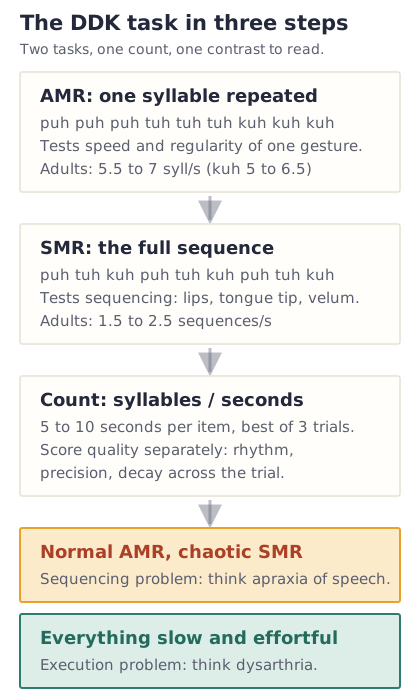
The diagnostic gold is in the contrast: intact AMRs with a collapsing SMR points toward sequencing/programming problems (apraxia of speech); uniformly slow, effortful AMRs and SMR point toward execution problems (dysarthria).
In session: the procedure that produces usable numbers
Norms (syllables per second)
Consolidated reference ranges from the literature - treat as anchors, not cutoffs:
Swipe the table to see every column
| Task | Adults | Age 6–7 | Age 9–10 |
|---|---|---|---|
| puh (AMR) | 5.5 – 7 | ~3.5 – 4.5 | ~4.5 – 5.5 |
| tuh (AMR) | 5.5 – 7 | ~3.5 – 4.5 | ~4.5 – 5.5 |
| kuh (AMR) | 5 – 6.5 | ~3 – 4 | ~4 – 5 |
| puh-tuh-kuh (SMR) | ~1.5 – 2.5 seq/s (4.5 – 7.5 syll/s) | ~1 – 1.5 seq/s | ~1.3 – 2 seq/s |
Published norms vary with instructions and measurement method; within-client change over time is more decision-worthy than any single cross-sectional number.
Try the protocol in 5 seconds: tap once per syllable and compare with the norms above.
Interpretation profiles
| DDK profile | Points toward |
|---|---|
| Slow, regular, imprecise everywhere | Dysarthria |
| Normal AMR, chaotic SMR | Apraxia of speech |
| Fast, irregular, degrades when pushed | Cluttering |
| Normal DDK, complaints in connected speech | Look elsewhere: fluency, discourse organization |
That third profile is the chronically missed one: many people who clutter pass an isolated pataka but lose control precisely when rate exceeds their monitoring capacity - which is why a DDK should be paired with connected-speech rate measurement. (Our cluttering assessment protocol covers that pairing.)
The measurement problem - solved
Counting syllables with a stopwatch while simultaneously judging articulatory precision is two jobs at once, and inter-rater reliability shows it.
Talk Slower does the counting. The analysis engine counts syllables live from the mic, timestamps each trial, and returns rate per attempt - while you watch the only thing software can't: movement quality. DDK results file into the client's record next to their connected-speech rates (in SPS, same unit, same engine), comparable across every re-assessment. The same platform then handles home practice with real-time rate biofeedback and remote monitoring between sessions.
Objective assessments. Visible home practice.
30-day free trial, no credit card. Always free for your clients.
Start the free 30-day trialFAQ - your questions about DDK testing
What is a normal DDK rate for adults?
Single-syllable AMRs around 5–7 syllables per second (kuh slightly slower than puh/tuh), and the full puh-tuh-kuh sequence around 1.5–2.5 sequences per second. Regularity and precision matter as much as raw speed.
What does slow DDK with normal speech mean?
Possibly nothing - task anxiety, unfamiliarity, or a one-off. Repeat across trials and sessions before concluding. The reverse pattern (normal DDK, disordered connected speech) is the one that should redirect your assessment toward fluency and discourse.
DDK differences between apraxia and dysarthria?
Dysarthria degrades execution: slow, effortful, but consistently patterned AMRs and SMR. Apraxia degrades sequencing: AMRs can be near-normal while puh-tuh-kuh derails - searching behavior, transposed syllables, inconsistent errors.
How many trials should I average?
Three trials per item, take the best (not the mean) for rate, and note consistency across trials as its own observation. Automated timing removes the biggest source of scoring noise.
Key takeaways
General information only: it does not replace the advice of a speech-language pathologist or a doctor. Talk Slower is not a medical device.
Updated August 16, 2026

I built Talk Slower after my own cluttering therapy. I wanted to create the tool my speech-language pathologist would have prescribed if it had existed: objective SPS measurement, at-home exercises, remote tracking. The app keeps evolving by staying close to speech-language pathologists.