"Nobody can hear me anymore." Nine times out of ten, it is not the person with Parkinson's who says it - it is the spouse. Hypophonia, the reduced vocal loudness characteristic of Parkinson's disease, has a cruel property: the speaker hears themselves as normal, because the disease recalibrates their perception of their own loudness. They speak at 55 dB, experience it as 70, and accuse the family of going deaf.
That is exactly why the evaluation must be quantified. You do not convince someone to work on their voice with impressions. You convince them with a phonation time of 9 seconds where the benchmark expects 15, and a curve they can see.
In short: in parkinsonian hypophonia, self-report is structurally biased - the speaker hears themselves as normal. So the evaluation rests on external measures (MPT, DDK, reading rate) plus a perceptual rating that stays entirely yours. A gap between collapsed measures and low perceived impact is not noise: it is the finding.
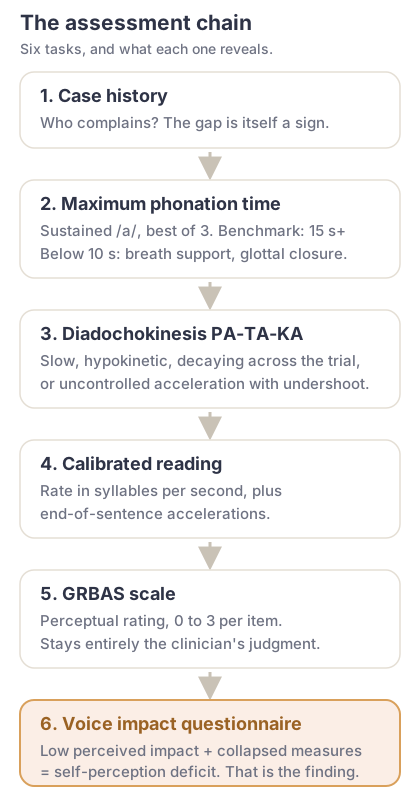
The pathway at a glance: here is the voice & speech assessment built into the app, task by task, with a sample results screen (fictional data). The neighboring tabs show the cluttering and stuttering assessments - same mechanics.
Hypophonia and hypokinetic dysarthria, briefly
Hypophonia is a neurologically based reduction of vocal intensity - the cardinal voice symptom of the hypokinetic dysarthria seen in Parkinson's disease, which affects the large majority of people over the course of the disease. It typically travels with monotone speech (reduced pitch variation), breathiness or roughness, paradoxical rate acceleration (festinating speech), and impaired self-perception: the person does not hear themselves speaking quietly.
That last point changes everything for assessment: self-report alone is structurally biased. External measures are mandatory.
In session: the evaluation, task by task
1. Case history and voice complaint
Who complains (the person or the family - the gap is itself a sign), since when, in which situations (phone, groups, noise), medication schedule and on/off fluctuations. Schedule the testing away from on/off extremes and note it in the report: measures only compare if conditions are reproducible at T1.
2. Maximum phonation time (MPT)
A sustained /a/ held as long as possible, best of three trials. A single adult reference: under 10 seconds = short time, worth exploring (values vary with age and sex, and no reference applies before age 13). A short time makes glottal closure and breath support the first leads to explore. The app times it on the audio - no more "roughly".
3. Diadochokinesis (PA-TA-KA)
The typical parkinsonian profile: slow, hypokinetic, decaying across the trial - or conversely an uncontrolled acceleration with articulatory undershoot. Tempo and regularity are measured automatically; DDK norms and interpretation are here.
4. Calibrated reading
A standard passage, rate measured in syllables per second, plus end-of-sentence accelerations - the signature of parkinsonian speech that reading reveals better than conversation. For reference values, see our speech rate norms guide.
5. The GRBAS scale
The reference perceptual rating (Grade, Roughness, Breathiness, Asthenia, Strain - each 0 to 3). It remains entirely yours: the app presents the audio and the grid side by side, stores your rating and brings it back at the next assessment. Automating GRBAS would make no clinical sense - the principle of the built-in assessments is to automate measurement, never judgment.
6. Voice impact questionnaire
Perceived handicap (a built-in voice impact scale) - often dissociated from the measures in Parkinson's, and that dissociation is information: low perceived impact with collapsed measures signals the self-perception deficit, and points therapy toward recalibration (learning to "speak too loud" in order to speak normally).
Worked case: “Mr. R.”, 68
Fictional case, realistic numbers - Parkinson's for 5 years, referred by the neurologist, complaint carried by his wife.
Swipe the table to see every column
| Task | Result | Benchmark |
|---|---|---|
| MPT /a/ (best of 3) | 9.2 s | short time under 10 s |
| DDK PA-TA-KA | 3.9 syll/s, irregular, decaying | 4.5 – 7.5 syll/s |
| Reading rate | 5.9 SPS with final accelerations | 4 – 5 SPS |
| GRBAS | G2 R1 B2 A1 S1 | clinician-rated |
| Perceived voice impact | 24 / 40 | moderate measure/perception dissociation |
Report language:
"Maximum phonation time is short (9.2 s, under the 10 s adult reference), diadochokinesis is slow and irregular with within-trial decay, reading rate accelerates at phrase endings, in a context of moderate breathiness and roughness (G2 B2). The picture is consistent with hypokinetic dysarthria with hypophonia. Plan: loudness and vocal projection work with visual feedback, prosodic training, quantified home practice between sessions; re-evaluation at 3 months on the same tasks."
That last sentence is not decorative: "re-evaluation on the same tasks" is only feasible if tasks are standardized and measures stored. That is what the automatic T0 → T1 comparison is for.
Objective assessments. Visible home practice.
30-day free trial, no credit card. Always free for your clients.
Start the free 30-day trialFrom assessment to therapy: closing the loop
The parkinsonian evaluation lands on a therapeutic paradox: the approaches with the strongest evidence (intensive loudness-based programs such as LSVT LOUD) demand daily, intensive practice, while reimbursed sessions are weekly. The workable answer is an equipped home program: the client practices with real-time visual feedback on loudness (the same analysis engine as the assessment), and you monitor the curves remotely.
And because parkinsonian speech declines slowly, the re-assessment becomes the pivot of long-term care: same tasks, automatic comparison, and a 12-month MPT/DDK curve that documents maintenance (or justifies intensification) better than any impression.
The app includes, on the same mechanics and the same client chart, a cluttering assessment protocol and a stuttering assessment by age - one tool, three pathways, useful for mixed caseloads.
FAQ - your questions about parkinsonian speech
What exactly is hypophonia?
A pathological reduction of vocal loudness of neurological origin - distinct from a weak voice caused by laryngeal lesions or habit. In Parkinson's disease it results from rigidity and hypokinesia applied to the respiratory and laryngeal systems, and comes with impaired self-perception: the person does not notice they are speaking quietly.
Why can't the person hear that they speak too quietly?
The disease alters sensorimotor calibration: a "normal" vocal effort now produces reduced loudness, but the internal feedback still reads as usual volume. Hence the value of objective visual feedback (decibels, curves) in both assessment and therapy: an external measure replaces the failing perception.
Can the GRBAS scale be automated?
No, and it should not be: it is a perceptual rating whose value rests on the trained clinical ear. What is worth automating around it: standardized recording, timing (MPT, DDK), storage of your ratings and their comparison across assessments.
How often should Parkinson's speech be re-assessed?
Every 3 to 6 months during active therapy, yearly in maintenance - adjusted to disease progression and medication changes. What matters most is comparability: same tasks, on/off state noted, measures stored.
Does this assessment replace an ENT or neurological workup?
No. Any dysphonia warrants laryngeal examination when in doubt, and the speech evaluation sits inside coordinated care (neurologist, ENT). The app produces measures and a structured report; diagnosis remains clinical and multidisciplinary.
Key takeaways
General information only: it does not replace the advice of a speech-language pathologist or a doctor. Talk Slower is not a medical device.
Updated August 16, 2026

I built Talk Slower after my own cluttering therapy. I wanted to create the tool my speech-language pathologist would have prescribed if it had existed: objective SPS measurement, at-home exercises, remote tracking. The app keeps evolving by staying close to speech-language pathologists.