Stuttering assessment has an uncomfortable property: what you can hear is not what matters most. One client produces 2% stuttered syllables in your office and organizes their entire life around avoidance; another stutters on every third word and is doing fine. An evaluation that reduces stuttering to a disfluency count misses the disorder.
This guide walks through the full protocol - objective measures and the invisible part - adapted to each age band, with a worked case and report language you can reuse.
In short: %SS is meaningless on its own. It only means something compared across three speaking conditions, and the slope is what gives you the therapeutic lever. Low %SS with massive avoidance is still stuttering. The submerged part quantifies too: iceberg, avoidance hierarchy, tension map.
Start with the essential tool: Sheehan's iceberg, the simplest and most powerful instrument in a stuttering evaluation. Check what you observe in a client (or experience yourself) - and watch the above/below-surface split build.
The three questions an evaluation must answer
A report that answers these three questions with data holds up - with the referring physician, with insurers, and with yourself at re-evaluation.
The protocol by age
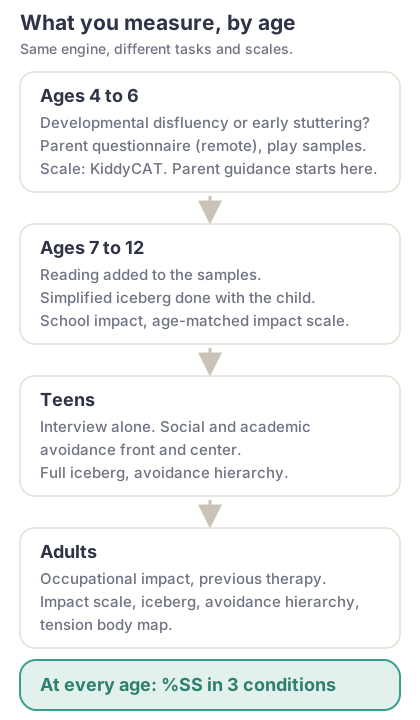
The assessment built into the app adapts the pathway to age (same engine, different tasks and scales):
Swipe the table to see every column
| Age | What changes | Scales |
|---|---|---|
| 4 – 6 | Parent questionnaire is central, samples collected through play, parent guidance starts at the eval | KiddyCAT, parent questionnaire completed remotely |
| 7 – 12 | Reading added, simplified iceberg done with the child, school impact explored | Age-matched impact scale |
| Teen | Social and academic avoidance front and center, interview alone | Full iceberg, avoidance hierarchy |
| Adult | Occupational impact, history of previous therapy | Impact scale, iceberg, avoidance hierarchy, tension body map |
The parent questionnaire deserves a highlight: in the app, it goes out by email and is completed remotely before the first appointment. You open the evaluation with the answers already in the chart - 20 minutes of case history saved.
In session: three speaking conditions, not one
Percent syllables stuttered (%SS) only becomes meaningful compared across conditions. The minimal set: spontaneous speech, reading, singing.
Worked example - “Lina”, age 9 (fictional case, realistic numbers):
Swipe the table to see every column
| Condition | %SS | Clinical read |
|---|---|---|
| Spontaneous speech | 7.2% | established stuttering (common benchmark: > 3%) |
| Reading | 4.1% | structure helps, without normalizing |
| Singing | 0.8% | near-normal fluency - a therapy lever |
This descending profile (spontaneous > reading > singing) is classic and directly usable in therapy: what produces fluency in singing (constrained rate, continuous voicing) is exactly what fluency shaping techniques train.
Hand-counting stuttered syllables across three samples is the longest part of the evaluation. In the app, the analysis engine transcribes and time-stamps each sample, pre-fills the counts (with a visual marker on everything that was auto-detected), and you adjust after playback - clinical judgment keeps the last word, especially on silent blocks that audio alone underestimates.
Where the SSI-4 fits
The Stuttering Severity Instrument (SSI-4) remains the reference norm-referenced severity measure: frequency (%SS), duration of the longest stutters, and physical concomitants, combined into a severity rating. The app does not replace it - it removes the tedious part (frequency counts and durations arrive pre-measured from the audio) so the instrument's scoring takes minutes instead of an evening.
Objective assessments. Visible home practice.
30-day free trial, no credit card. Always free for your clients.
Start the free 30-day trialThe submerged part: what reports forget
Sheehan's iceberg
The interactive module at the top of this article shows the principle; in the built-in assessment the iceberg is rated with the client (or the parents), age-adapted, and tracked from one evaluation to the next. An iceberg that "surfaces" over the course of therapy - less shame, less avoidance - is often a better progress marker than %SS.
The avoidance hierarchy
A graded list of avoided situations (phone calls, speaking up in meetings, ordering at a restaurant…). It becomes the transfer roadmap: graded exposure from easiest to most feared.
The tension body map
Where does the client localize the struggle: jaw, throat, breath, shoulders? This mapping targets the release work and is compared at the next assessment.
Report language (template, adapt as needed):
"Percent syllables stuttered ranges from 0.8% (singing) to 7.2% (spontaneous speech), consistent with established stuttering with strong contextual reactivity. Functional impact extends beyond the audible dimension: the impact scale is elevated, the iceberg reveals anticipation and avoidance (oral reading avoided at school), tension localized to jaw and breath. The treatment plan will combine fluency shaping (singing/guided reading lever), desensitization, and family involvement."
What the pathway looks like in the app
Each task runs with on-screen instructions, built-in recording and pre-filled measures - here is the interactive summary (fictional data; the neighboring tabs show the cluttering and Parkinson's assessments, same mechanics):
At the end of the pathway: a pre-drafted Word report (measures, scales, careful phrasing - you keep control of every sentence), per-task audio playback, and automatic T0 → T1 comparison at re-evaluation.
Stuttering, cluttering… or both?
A substantial share of fluency evaluations reveal a mixed picture. If rate is fast, disfluencies mostly non-stuttering-like (telescoping, revisions) and awareness low, think cluttering: the differential guide is here, and the app's cluttering assessment protocol runs on the same engine and the same client chart. For neurological caseloads, the app also includes a Parkinson's voice and speech assessment (MPT, PA-TA-KA, GRBAS).
All built-in assessments carry a Beta badge and the note "an orientation aid, to be confirmed clinically": the app produces measures and quantified profiles, never a diagnosis.
Objective assessments. Visible home practice.
30-day free trial, no credit card. Always free for your clients.
Start the free 30-day trialFAQ - your questions about stuttering assessment
At what %SS does stuttering start?
The common benchmark is around 3% stuttered syllables, but it is not sufficient on its own: disfluency type (sound repetitions, prolongations, blocks), tension and impact matter as much as frequency. Low %SS with massive avoidance is still stuttering - often called covert stuttering.
Should a 4-year-old be assessed like an adult?
No. In preschoolers the question is developmental disfluency vs early stuttering plus persistence risk factors; the scales (KiddyCAT, parent questionnaire) and the play-based administration change. The app's 4-6 pathway is built on that logic, remote parent questionnaire included.
How do you quantify the invisible part of stuttering?
With dedicated tools: Sheehan's iceberg (above/below-surface experience), validated age-matched impact scales, an avoidance hierarchy, a tension body map. None requires equipment - only administration time, which automated counting frees up.
Can a stuttering evaluation be done via telepractice?
Speech samples record well remotely and the parent questionnaire is designed for it. Tension observation and the clinical interview are richer in person - a hybrid format (samples and questionnaires remote, interview in the room) works well in practice.
Key takeaways
General information only: it does not replace the advice of a speech-language pathologist or a doctor. Talk Slower is not a medical device.
Updated August 16, 2026

I built Talk Slower after my own cluttering therapy. I wanted to create the tool my speech-language pathologist would have prescribed if it had existed: objective SPS measurement, at-home exercises, remote tracking. The app keeps evolving by staying close to speech-language pathologists.