Someone you care about has had a stroke, and their speech is not the same. Words go missing, or the words are there but come out slurred and hard to follow. The discharge summary says "aphasia" on one line and "dysarthria" on another, and nobody took five minutes to explain which is which. Or you are a speech-language pathology student who knows the textbook definitions and wants the bedside clues that actually separate the two.
In short: aphasia is a language problem: the words, the grammar, the understanding. Dysarthria is a speech problem: the muscles that shape and voice the words. A person with dysarthria knows exactly what to say and can usually write it correctly; they cannot pronounce it clearly. A person with aphasia may articulate perfectly and still not find the word. Both can follow the same stroke, and they are treated very differently.
The one-sentence difference
Think of the path from an idea to a spoken sentence as a chain. First the brain has to choose words and build a sentence (language). Then it has to plan the precise sequence of movements for the lips, tongue, jaw, soft palate, and larynx (motor planning). Then the muscles have to carry that plan out with enough strength, speed, range, and coordination (execution).
Aphasia breaks the first link. Dysarthria breaks the last one. That is the whole difference, and everything else in this article is a way of hearing it, testing it, and acting on it.
A useful image: the librarian and the reading voice. In aphasia, the librarian cannot find the right book, or brings the wrong one, or cannot read what is on the page. In dysarthria, the librarian finds the right book every time but reads it aloud with a mouth full of marbles. The content is intact. The delivery is not.
Three levels, not two: where apraxia of speech fits
Clinicians actually work with three levels, because the middle link can break on its own. When the planning stage is damaged, the result is apraxia of speech: the person knows the word, the muscles are strong, but the instructions for sequencing the movements are scrambled. You hear groping, false starts, a word produced correctly and then wrong on the next try.
Swipe the table to see every column
| Level | What is damaged | Name | What you hear |
|---|---|---|---|
| Language | Choosing words, building sentences, understanding | Aphasia | Missing words, wrong words, broken grammar, sometimes poor comprehension |
| Motor planning | Programming the sequence of speech movements | Apraxia of speech | Groping, trial and error, inconsistent errors, better on automatic phrases |
| Execution | Strength, speed, range, coordination of the speech muscles | Dysarthria | Slurred, weak, slow, strained, or nasal speech, with correct sentences |
Aphasia and apraxia of speech often travel together after a left-hemisphere stroke, which is why "aphasia vs apraxia" is such a frequent question. The difference is the same principle one level up: aphasia is the wrong word or no word, apraxia is the right word that the mouth cannot assemble.
Aphasia vs dysarthria: side by side
Swipe the table to see every column
| Aphasia | Dysarthria | |
|---|---|---|
| What is impaired | Language itself: word retrieval, grammar, comprehension, reading, writing | Speech execution: breathing, voice, articulation, resonance, prosody |
| What you hear | Word-finding pauses, substitutions ("fork" for "spoon"), jargon, telegraphic sentences, or fluent but empty speech | Slurred, weak, slow, strained, monotone, or nasal speech; the words and sentences are correct |
| Writing | Impaired in the same way as speech (wrong words, missing grammar) | Intact in content; handwriting may be shaky for motor reasons, but the language is right |
| Comprehension | Often affected, especially in fluent (Wernicke's-type) aphasia | Normal |
| Awareness | Variable: high in non-fluent aphasia, frequently reduced in fluent aphasia | Usually high; the person knows they sound different and is often frustrated by it |
| Typical causes | Left-hemisphere stroke, brain tumor, traumatic brain injury, primary progressive aphasia | Stroke (any side, brainstem included), Parkinson's disease, ALS, multiple sclerosis, cerebellar damage, cranial nerve injury |
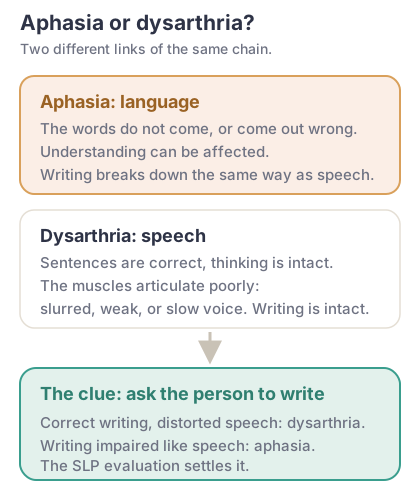
Two notes on the table. Dysarthria is not one thing: the classic Mayo Clinic classification (Darley, Aronson, and Brown, 1969) describes flaccid, spastic, ataxic, hypokinetic, hyperkinetic, and mixed forms, each tied to a different part of the motor system. And "fluent but empty" aphasia is the one families most often miss, because the voice sounds normal and the sentences have melody. Listen to the content, not the sound.
How an SLP tells them apart at the bedside
No single test settles it, but five quick observations point strongly in one direction. Speech-language pathologists use them in the first minutes of an evaluation.
1. The writing test. Ask the person to write what they wanted to say (if the hand allows it). Correct writing with distorted speech points to dysarthria: the language is there, the mouth is not delivering it. Writing that breaks down the same way as the speech points to aphasia. This is the single most useful clue a family can observe at home.
2. Repetition. Ask the person to repeat a sentence. In dysarthria, they repeat it faithfully and it sounds slurred, in the same way their own sentences do. In aphasia, repetition can fail in ways that have nothing to do with articulation: words dropped or substituted, the sentence restructured, or, in conduction aphasia, repeated attempts that circle the target.
3. Automatic speech. Counting to ten, the days of the week, a familiar song. People with aphasia and apraxia often produce these far better than anything propositional. A person with dysarthria sounds equally slurred on "one, two, three" and on a new sentence, because the muscles are the problem regardless of the content.
4. Consistency of errors. Dysarthric errors are consistent: the same sounds are distorted the same way across attempts and contexts, because the impairment is physical. Apraxic errors are inconsistent and accompanied by visible groping. Aphasic errors are about the word, not the sound: "chair" becomes "table," not "shair."
5. The oral-motor exam. The clinician looks at the face, lips, tongue, and soft palate at rest and in movement: symmetry, strength, range, speed, and the diadochokinetic rate ("puh-tuh-kuh" as fast as possible). Weakness, slowness, or reduced range point to dysarthria. A normal oral-motor exam with disordered language points to aphasia.
If you want to try this reasoning on what you are seeing, the sorter below does exactly that. It is an indicative tool, not a diagnosis.
Can you have both aphasia and dysarthria?
Yes, and after a stroke it is common. A large left-hemisphere stroke can damage the language areas and the motor pathways at the same time, leaving someone who both cannot find the word and cannot articulate the words they do find. Apraxia of speech can be in the mix too. Conditions such as primary progressive aphasia can also acquire a motor speech component as they evolve.
This is why the speech-language pathologist's evaluation matters more than the labels on the discharge summary. The report should say not only "aphasia" or "dysarthria," but which components are present, how severe each one is, and which one is currently limiting communication the most. That ranking drives the therapy plan.
Objective assessments. Visible home practice.
30-day free trial, no credit card. Always free for your clients.
Start the free 30-day trialWhat each one means for treatment
Aphasia: language therapy
Aphasia therapy targets the language system: word retrieval, sentence building, comprehension, reading, and writing, together with strategies that keep communication going when a word will not come (gesture, drawing, writing the first letter, a communication partner who knows how to help). The Cochrane review on speech and language therapy for aphasia after stroke (Brady and colleagues, 2016) supports therapy over no therapy and suggests that higher intensity is associated with better outcomes, with the caveat that intensive schedules are harder to tolerate early on. In practice, the dose that the person can sustain over weeks beats the heroic dose that ends in week two.
One honest line here, because this site is built around a speech-rate app: Talk Slower does not treat aphasia. It does not work on naming, comprehension, or word retrieval. For aphasia, the people to talk to are a speech-language pathologist and an aphasia support organization. I would rather say that clearly than let a reader buy the wrong tool.
Dysarthria: rate, loudness, articulation, prosody
Dysarthria therapy works on the execution system, and it leans on a handful of levers that are remarkably consistent across the dysarthria types (Duffy, 2019):
This is where a speech-rate app honestly fits. Rate control is hard to self-monitor, because the speaker cannot hear how fast they are from the inside. A tool that measures speech rate in syllables per second and shows it in real time gives the person and their SLP an objective number to work toward between sessions. Talk Slower does that for speech: rate, pacing, biofeedback. It is not a medical device and it does not diagnose anything. It is a practice tool for dysarthria rate control, used alongside a clinician, and nothing more than that.
In session: what actually helps
For families and care partners, the labels matter less than what to do at the table tonight. The actions differ by condition, so sort first, then act.
When to seek help
Any sudden change in speech or language is a medical emergency. New slurred speech, new difficulty finding words, new trouble understanding, a drooping face, or weakness on one side: call 911 (or your local emergency number) immediately, even if it passes after a few minutes. A transient episode can be a warning sign of stroke, and treatment is time-critical.
Beyond the emergency, a speech-language pathology evaluation is warranted when speech or language has changed after a known neurological event, when a progressive condition (Parkinson's disease, ALS, multiple sclerosis) is starting to affect intelligibility or word-finding, when family members report that they understand the person less than they did six months ago, or when the person is withdrawing from conversation because of it.
What does not warrant alarm: occasional tip-of-the-tongue moments in a healthy adult, slurring when very tired or after alcohol, or a lifelong fast and mumbled speaking style that has not changed. Those are not aphasia or dysarthria. A fast, collapsing delivery that has always been there is more likely cluttering, a fluency disorder with its own path.
FAQ - your questions about aphasia and dysarthria
Is dysarthria a type of aphasia?
No. They sit at different levels of the chain. Aphasia is a disorder of language (words, grammar, comprehension) caused by damage to the brain's language network. Dysarthria is a motor speech disorder: the language is intact, but the muscles that produce speech are weak, slow, or poorly coordinated. They can coexist after the same stroke, but neither one is a subtype of the other.
Can aphasia cause slurred speech?
Not by itself. Slurring is a motor sign and points to dysarthria, or in some cases to apraxia of speech. Aphasia produces missing words, wrong words, and broken grammar, usually with clear articulation. When someone with aphasia also slurs, it is because a co-occurring dysarthria or apraxia is present, which is common after a large left-hemisphere stroke.
Which is worse, aphasia or dysarthria?
Neither is "worse" as a category; severity ranges from mild to profound in both. In daily life, severe aphasia tends to be more isolating because it can affect understanding, reading, and writing as well as speaking, so every channel of communication is touched. Severe dysarthria can make a person unintelligible, but writing, typing, and comprehension remain available as alternatives. Ask the speech-language pathologist about the impact on this person's communication rather than about the label.
How does an SLP tell aphasia and dysarthria apart?
Through a handful of bedside observations before any formal test: whether writing breaks down the same way as speech (aphasia) or stays correct (dysarthria), whether repetition and automatic speech are relatively spared (aphasia, apraxia) or equally slurred (dysarthria), whether errors are consistent (dysarthria) or variable with groping (apraxia), and what the oral-motor exam shows. Formal language and motor speech assessments then confirm the picture.
What is the difference between aphasia, dysarthria, and apraxia of speech?
They correspond to three levels. Aphasia: the language is damaged (the wrong word or no word). Apraxia of speech: the word is known but the brain cannot program the sequence of movements (groping, inconsistent errors, better on automatic phrases). Dysarthria: the plan is fine but the muscles cannot execute it precisely (consistent slurring, weakness, slowness).
What is expressive aphasia vs dysarthria?
Expressive (Broca's-type) aphasia is the non-fluent form of aphasia: short, effortful, telegraphic sentences with missing grammar, usually with good comprehension. It can sound labored, which is why it gets confused with dysarthria. The difference is the content: the person with expressive aphasia drops words and grammar, and their writing shows it; the person with dysarthria produces complete, correct sentences that are hard to hear clearly.
Can a speech app help with aphasia or dysarthria?
For dysarthria, a speech-rate app can support one specific lever, rate control, by measuring speed in syllables per second and giving real-time feedback between sessions with an SLP. That is what Talk Slower does. It does not help with aphasia: it does not train naming, comprehension, or word retrieval, and it is not a medical device. For aphasia, look for an SLP and an aphasia support organization.
Key takeaways
General information only: it does not replace the advice of a speech-language pathologist or a doctor. Talk Slower is not a medical device.
Updated August 23, 2026
Further reading

I built Talk Slower after my own cluttering therapy. I wanted to create the tool my speech-language pathologist would have prescribed if it had existed: objective SPS measurement, at-home exercises, remote tracking. The app keeps evolving by staying close to speech-language pathologists.