You have a discharge summary in your hands, or a referral on your desk, and it says "global aphasia", "conduction aphasia", or "anomic aphasia". You want to know what that label says about the person: what they can still do, what you will hear when they speak, and what it changes for the work ahead. This guide walks through each type of aphasia in the same order and with the same structure, so you can compare them side by side.
In short: the classical (Boston) types of aphasia are sorted by three questions: is speech fluent, is comprehension preserved, and can the person repeat? Global aphasia fails all three; anomic aphasia passes all three and leaves only word-finding trouble. The type is a snapshot that changes over the weeks after a stroke, and most real patients sit between two boxes. It orients therapy; it does not replace a full language assessment.
Aphasia is an acquired disorder of language (words, sentences, comprehension, reading, writing) caused by damage to the language network, most often in the left hemisphere. It is not a disorder of intelligence, nor of the speech muscles (that is dysarthria, which can coexist with it). I am not a clinician: everything below follows the classical aphasia literature and the way speech-language pathologists (SLPs) and neurologists actually use these labels.
How the types are classified
The classification most reports still use comes from the Boston school (Goodglass and Kaplan, 1972, and the Boston Diagnostic Aphasia Examination). It rests on three observable dimensions:
A fourth dimension, naming, is impaired in every type to some degree, so it measures severity rather than separating the types. Three yes-or-no questions give eight theoretical profiles; primary progressive aphasia sits outside this grid, because it is a disease rather than a stroke syndrome.
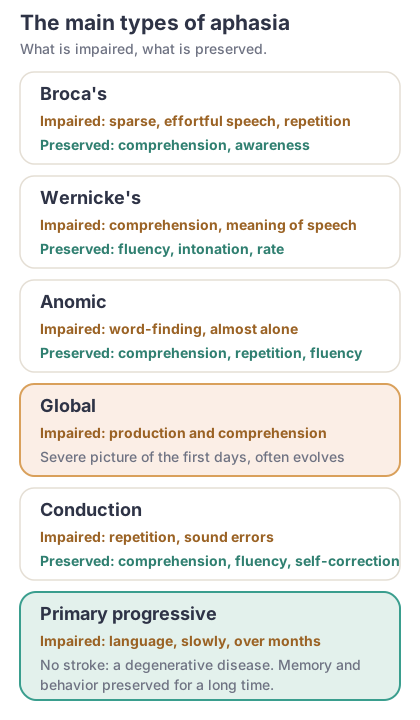
Global aphasia
What is impaired: everything. Spoken output, comprehension, repetition, naming, reading, and writing are all severely affected.
What is preserved: non-verbal communication, often surprisingly well: facial expression, gesture, tone of voice, drawing. Some automatic sequences (counting, days of the week, a swear word, a song) can come out intact.
What you hear: very little. Sometimes a single recurring utterance produced for every intention ("tono, tono, tono"), sometimes only "yes" and "no", and not always reliably.
What it means for therapy: in the first weeks the picture often shifts, so the immediate priority is to give the person a reliable channel (yes/no, pointing, pictures) and to train the people around them, not to drill words.
Broca's aphasia (expressive, non-fluent)
What is impaired: producing language. Sentences are short and stripped of grammar ("Wife... store... Tuesday"), articulation is effortful, and word-finding is slow. Writing shows the same agrammatism. Repetition of sentences is poor.
What is preserved: comprehension of everyday conversation is relatively good, and the person knows exactly what they want to say. That awareness is why frustration and low mood are so frequent in this type.
What you hear: "Uh... coffee... no... cup. Cup... wan'... coffee." Content words survive, function words and verb endings disappear, and every word costs effort.
What it means for therapy: comprehension is your ally. Work on production, sentence structure, and intensive speaking practice; apraxia of speech often coexists and needs its own plan. The full picture is in expressive aphasia: symptoms, causes, and recovery.
Wernicke's aphasia (receptive, fluent)
What is impaired: comprehension of language, and the meaning of what the person produces. Speech is abundant but carries little information, with wrong words (paraphasias) and sometimes invented ones (neologisms). Reading comprehension and writing are affected in parallel. Repetition is poor.
What is preserved: the mechanics of speech. Articulation, phrase length, intonation, and rate all sound normal, which is precisely why family members find this type so disconcerting.
What you hear: "Well, I went down the thing, the one with the, you know, and it was all frimmering, so I told her to get the bascot." Fluent, melodic, and largely empty.
What it means for therapy: the person often does not hear their own errors, so self-monitoring is low and comprehension comes first. Nothing built on "listen and repeat" will hold until some auditory comprehension has returned.
Objective assessments. Visible home practice.
30-day free trial, no credit card. Always free for your clients.
Start the free 30-day trialConduction aphasia
What is impaired: repetition, out of proportion to everything else. The person also makes sound-level errors (phonemic paraphasias: "tabe" for "table", "flish" for "fish"), hears them, and tries to fix them through successive approximations, a behavior called conduite d'approche.
What is preserved: fluency and comprehension. Conversation flows, the person follows what you say, and their awareness of errors is high.
What you hear: "Pass me the... sall, salt... no, sollt... salt. Yes, salt." The target is clearly there; the path to it keeps slipping.
What it means for therapy: the phonological system is the target. Repetition practice, phonological tasks, and working with the person's own self-correction are productive because monitoring is intact.
Anomic aphasia
What is impaired: word retrieval, almost in isolation. The person knows what they mean, can describe it, can recognize the word instantly when you say it, but cannot pull it out. Nouns are hardest, especially proper names and low-frequency words.
What is preserved: fluency, comprehension, repetition, grammar. To a stranger the speech can sound normal, only a little vague and full of circumlocutions.
What you hear: "Hand me the... the thing you cut with... the... it's on the counter... yes, knife, thank you."
What it means for therapy: word retrieval is trainable, and the person's intact comprehension and monitoring make them an active partner. This is the home ground of semantic and phonological cueing approaches.
The transcortical aphasias (brief)
The three transcortical types share one feature that looks paradoxical at the bedside: repetition is preserved, sometimes to the point of echoing the examiner, while spontaneous language is badly damaged. Classically they follow watershed lesions between arterial territories, which leave the perisylvian language core intact but isolated from the rest of the brain.
What it means for therapy: preserved repetition is a lever, not communication in itself: a way in for shaping output (motor) or for pairing heard forms with meaning (sensory).
Primary progressive aphasia (three variants)
Every type above appears suddenly, after a dated event. Primary progressive aphasia (PPA) does the opposite: language declines over months to years, with no stroke, while memory and behavior are initially spared. It is a neurodegenerative disease, first described as a syndrome by Marsel Mesulam in 1982, and it belongs to the neurologist, not to the emergency department.
The 2011 consensus criteria (Gorno-Tempini and colleagues) recognize three variants:
What it means for therapy: the goal is not recovery but maintaining communication for as long as possible: targeted word relearning while it still holds, and preparing communication supports (written phrases, picture books, a communication app) before they are urgently needed.
The Boston classification table
Swipe the table to see every column
| Type | Fluency | Comprehension | Repetition | Naming | Hallmark |
|---|---|---|---|---|---|
| Global | Non-fluent | Impaired | Impaired | Impaired | Everything affected; often evolves |
| Broca's | Non-fluent | Preserved | Impaired | Impaired | Telegraphic, effortful, aware |
| Transcortical motor | Non-fluent | Preserved | Preserved | Impaired | Says little, repeats well |
| Mixed transcortical | Non-fluent | Impaired | Preserved | Impaired | Global picture with echo |
| Wernicke's | Fluent | Impaired | Impaired | Impaired | Abundant, empty, unaware |
| Transcortical sensory | Fluent | Impaired | Preserved | Impaired | Wernicke's picture, repeats well |
| Conduction | Fluent | Preserved | Impaired | Mild | Sound errors, self-corrects |
| Anomic | Fluent | Preserved | Preserved | Impaired | Word-finding, almost alone |
Primary progressive aphasia is deliberately absent from the table: its three variants are defined by the pattern of decline, and any of them can resemble a Boston type at a given moment.
If you want to see how a set of observed signs maps onto these profiles, the explorer below does exactly that. It is indicative only: the pure types are a minority, and only a language assessment by an SLP settles the question.
Why real patients rarely fit one box
Three honest caveats, which every SLP learns in the first month on a stroke unit.
Most aphasias are mixed. Lesions do not respect textbook boundaries. A person can be non-fluent with moderately impaired comprehension and partially preserved repetition, and "mixed non-fluent aphasia" is a legitimate label in a report. Published series leave a substantial minority of patients unclassifiable under the Boston scheme.
The type changes over weeks. In the first days after a stroke, swelling and diaschisis (the temporary shutdown of regions connected to the lesion) make the picture look worse and broader than the final lesion warrants. A global aphasia at day 3 often becomes a Broca's aphasia by week 6 and an anomic aphasia by month 6; a Wernicke's aphasia frequently settles into conduction or anomic aphasia as comprehension returns. The type in the acute discharge summary is a starting point, not a prognosis.
Localization is classical, not literal. The lesion sites above are textbook correlations. Modern lesion-symptom mapping confirms the broad strokes and complicates the details: fluency depends on wide frontal and insular networks, not one gyrus, and the same lesion produces different aphasias in different people. Use the sites as a mental map, not as a diagnosis by coordinates.
In session: what actually helps
The type does not dictate a method, but it orients the first choices. Here is how SLPs commonly translate each profile into a plan, always within a full language assessment and the person's own goals.
Where speech-rate tools fit
One boundary I keep explicit. Talk Slower measures and trains speech: rate in syllables per second, pausing, loudness, intelligibility. It does nothing for language, so it is not a tool for aphasia. Where it belongs is the person who, after the same stroke, also has dysarthria: slurred, fast, or monotone speech that the SLP wants to pace and measure between sessions. The distinction is laid out in aphasia vs dysarthria: the difference, with examples. For any language goal, the plan is the SLP's, not an app's.
When to seek help
Sudden onset is an emergency. Someone who suddenly cannot find words, speaks nonsense, or stops understanding you, whether or not there is facial droop or arm weakness, needs 911 (or your local emergency number) immediately. Note the time the symptoms began, because it determines which stroke treatments are possible. Do not wait to see whether it passes, and call even if it has passed: a transient episode can be a warning stroke.
Slow decline is a neurology appointment. Word-finding that has worsened over months in someone with no known stroke, sentences that have simplified, or words whose meaning seems lost, warrant a primary care visit this week and a referral to a neurologist for cognitive assessment and imaging. It is not an emergency, but it is not something to "watch a little longer" either.
A diagnosed aphasia with no therapy plan warrants an SLP assessment, at any stage.
What does not warrant alarm: an occasional tip-of-the-tongue moment, a proper name that escapes you after a long day, or swapping two words once in a conversation. Everyone does that. What matters is the change from before, and how quickly it appeared.
FAQ - your questions about the types of aphasia
What is the most common type of aphasia?
It depends on when you look. In the days after a stroke, global and Broca's presentations are frequent because the acute lesion affects a wide area. In people living with chronic aphasia, anomic aphasia is generally the most common pattern, both because mild strokes produce it directly and because most other types improve toward it.
What is the most severe type of aphasia?
Global aphasia, in which production, comprehension, repetition, reading, and writing are all severely impaired. It usually follows a large left-hemisphere stroke, and it very often evolves toward a less severe type over the following weeks and months, so the label on day 3 is not the final picture.
What is the difference between anomic and conduction aphasia?
Both are fluent, with good comprehension. The dividing line is repetition. In anomic aphasia, repetition is preserved and the only real problem is finding words. In conduction aphasia, repetition is severely impaired and speech contains sound-level errors (phonemic paraphasias) that the person hears and tries to correct.
What is the difference between Broca's and Wernicke's aphasia?
Broca's aphasia is non-fluent: few words, great effort, comprehension relatively preserved, high awareness. Wernicke's aphasia is fluent: abundant, melodic, largely meaningless speech, comprehension severely impaired, little awareness. Both have impaired repetition.
Is primary progressive aphasia a type of dementia?
Yes, in the sense that it is a neurodegenerative disease that progresses. It is classified among the frontotemporal lobar degeneration syndromes (the non-fluent and semantic variants) or linked to Alzheimer pathology (most logopenic cases). What sets it apart is that language declines first and alone, often for years, while memory and behavior are initially spared.
Can the type of aphasia change over time?
Yes, and it usually does. Recovery after a stroke typically moves from a more severe type toward a milder one: global toward Broca's, Wernicke's toward conduction or anomic, and almost anything toward anomic. Reassessment every few weeks in the first months is standard practice.
How is the type of aphasia determined?
By a language assessment with a speech-language pathologist, using a standardized battery such as the Boston Diagnostic Aphasia Examination or the Western Aphasia Battery, which score fluency, comprehension, repetition, and naming. Imaging locates the lesion but does not by itself classify the aphasia.
Key takeaways
General information only: it does not replace the advice of a speech-language pathologist or a doctor. Talk Slower is not a medical device.
Updated August 23, 2026
Further reading

I built Talk Slower after my own cluttering therapy. I wanted to create the tool my speech-language pathologist would have prescribed if it had existed: objective SPS measurement, at-home exercises, remote tracking. The app keeps evolving by staying close to speech-language pathologists.