Someone you know, or a patient on your caseload, had a stroke last week. They clearly understand what you are saying, they open their mouth, and two words come out where a sentence should be. They know what they want to say. The words will not come. That picture has a name: expressive aphasia, often called Broca's aphasia. This article is for the speech-language pathologist (SLP) who wants a precise, shareable reference, and for the family who wants to understand what is happening and what to do tonight.
In short: expressive aphasia is a language disorder, not a speech-muscle problem and not a loss of intelligence. Output is slow, effortful and telegraphic, while understanding is relatively preserved. The person is usually painfully aware of every failure. The cause is a brain lesion, most often a left-hemisphere stroke. Recovery is real, front-loaded in the first months, and dose-dependent. Sudden onset is an emergency: call 911.
What expressive aphasia is
Aphasia is an acquired loss or disruption of language after damage to the brain, in a person who spoke normally before. Expressive aphasia is the variant where the damage falls mainly on producing language: finding the words, ordering them, building a sentence. Understanding is relatively spared, which is exactly why it is so distressing. The person knows what they mean. The sentence is there, inside. The output channel is broken.
Three features define it in the clinic:
And one feature families notice before anything else: awareness is intact. The person hears their own errors, tries again, gets frustrated, sometimes cries. This is the opposite of receptive (Wernicke's) aphasia, where the speaker often does not perceive that anything is wrong.
What it sounds like: real examples
Abstract descriptions do not help a family recognize it. Utterances do. Here is what a person with expressive aphasia might produce, and what they meant.
| What they meant | What you hear |
|---|---|
| "I went to the hospital on Monday and they did a scan." | "Hospital... Monday... um... picture. Head." |
| "Can you call my daughter? Her name is Sarah." | "Phone... Sarah. Phone Sarah." |
| "I'm tired, I want to go to bed." | "Tired. Bed... go bed." |
| "The nurse said I could go home on Friday." | "Nurse... home. Fri... Friday. Home." |
| "Yes, I understand, but I can't say it." | "Yes. Yes. No... (taps head) ...know. Can't." |
What survives: the meaning is usually recoverable from the nouns. What is lost: word order, function words, verb tense, the glue. And the strategies many people discover on their own (repeating the key word, pointing, gesturing) are not failures. They are the beginnings of compensation, and good therapy builds on them.
Two other things you may hear. Automatic speech is often preserved: counting to ten, days of the week, a song, a swear word that comes out perfectly formed while "water" will not. And yes/no may be unreliable in the first days. Confirm with a gesture before acting on a spoken yes.
"Expressive" and "Broca's": the same thing?
Almost, and the nuance matters for anyone reading a medical report.
Expressive aphasia is a broad clinical label. It says: the main impairment is on the output side. It does not say how severe, or whether grammar is specifically broken.
Broca's aphasia is the classical syndrome, with a precise profile: non-fluent speech, agrammatism, impaired repetition, relatively preserved comprehension, usually with right-sided weakness. Every Broca's aphasia is expressive. Not every expressive difficulty is Broca's: a person with a milder anomic aphasia struggles to find words but speaks in fluent, grammatical sentences. The other profiles (anomic, conduction, global) are laid out in types of aphasia explained.
Two more honest clarifications:
Expressive vs receptive aphasia
The most searched comparison, and the one that prevents the most harmful mistakes at the bedside.
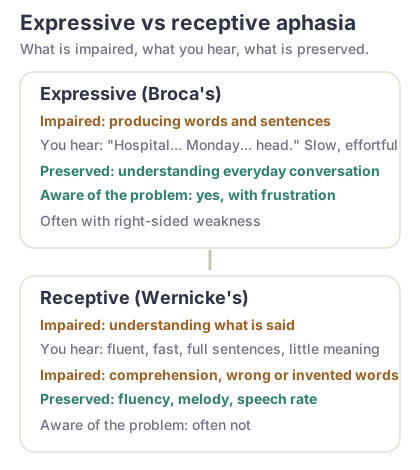
Swipe the table to see every column
| **Expressive (Broca's)** | **Receptive (Wernicke's)** | |
|---|---|---|
| What is impaired | Producing language | Understanding language |
| Fluency | Non-fluent, slow, effortful | Fluent, often fast, normal melody |
| What you hear | Short telegraphic bursts, missing grammar | Long sentences with little meaning, wrong words, invented words |
| Comprehension | Relatively preserved | Impaired |
| Repetition | Impaired | Impaired |
| Awareness of the problem | High, with frustration | Often low, with irritation at not being understood |
| Typical lesion | Left frontal, near the motor cortex | Left temporal, near the auditory cortex |
| Associated motor sign | Right-sided weakness is common | Often none |
A practical consequence: with expressive aphasia, talk normally and wait. With receptive aphasia, simplify and show. Pure forms are rare, especially early on, and a mixed picture is common. The explorer below is a starting point, not a verdict.
What causes expressive aphasia
The common thread is damage to the language network of the left hemisphere, which controls language in the vast majority of right-handed people and most left-handed people too.
What expressive aphasia is not
Three confusions cost people real harm, so they deserve their own section.
It is not dysarthria. Dysarthria is a speech disorder: the muscles of the lips, tongue, breath and voice are weak, slow or poorly coordinated, so words come out slurred, quiet or monotone. The language is intact: the person chooses the right words, in the right order, and could write the sentence perfectly. In aphasia the reverse is true: articulation may be clean, but the words and grammar are missing, in speech and in writing alike. The two frequently coexist after a stroke, and the SLP's first job is to tease them apart. The full comparison is in aphasia vs dysarthria.
It is not a loss of intelligence. Memory, reasoning, personality, humor, judgment: aphasia itself touches none of them. The person who cannot say "Tuesday" still knows what day it is, still knows who you are, still has opinions about the decisions being made around the bed.
It is not a hearing problem. Shouting does not help. The sound arrives fine; the difficulty is on the way out. Normal voice, normal pace, short sentences.
Objective assessments. Visible home practice.
30-day free trial, no credit card. Always free for your clients.
Start the free 30-day trialRecovery: what actually happens
Two forces work for the person, and neither replaces the other.
Spontaneous recovery. After a stroke, the brain reorganizes: swelling subsides, blood flow around the lesion stabilizes, neighboring regions take over part of the work. The fastest gains happen in the first weeks and months. A severe global aphasia of the first days commonly settles into a Broca's-type picture, which then often softens toward a milder anomic aphasia: shorter pauses, longer sentences, the word-finding problem remaining as the last trace. This window is also when therapy has the most leverage.
Rehabilitation. Speech-language therapy targets word retrieval, sentence construction, reading, writing, and very often alternative means of communication (gesture, writing single words, a communication book or app) for when speech is not enough. The goal is not only better sentences. The goal is getting the message across, today, by whatever channel works.
How much therapy? The RELEASE collaboration (Brady and colleagues, 2022), which pooled individual data from aphasia trials across many countries, found that higher dose and intensity of speech-language therapy were associated with larger language gains than low-dose, spread-out therapy. I will not put a number on "how much better", because it depends on severity, timing and the measure used. The practical message is enough: one session a week is a low dose, and practice between sessions, on tasks the SLP has chosen, is part of the treatment rather than an optional extra.
And a point that gives families room to breathe: there is no deadline. Gains slow down after the first year, but people with chronic aphasia continue to improve with targeted therapy years after the stroke, especially on what they practice.
What I cannot promise, and what no honest source promises: a return to exactly the language of before. Some people with a mild initial aphasia get there. Many recover useful, functional communication with a residual word-finding difficulty. The severity of the first days is the best early predictor, and even that is imperfect.
Therapy approaches that have a name
Families often hear these terms in a report. Each line describes the idea, not a guarantee. The SLP chooses based on the profile, and the list is not exhaustive.
So what do I actually do? The family's part
From tonight, without equipment, and without waiting for the first appointment.
Where Talk Slower fits (and where it does not)
Honesty about my own tool: Talk Slower does not treat aphasia. The app measures and trains speech: rate in syllables per second, pacing, loudness, articulation. It does not work on naming, comprehension, sentence construction or word retrieval, which are the targets in expressive aphasia. For aphasia, the right partner is a speech-language pathologist, and aphasia associations are the other resource worth knowing.
Where the app can be useful is the frequent case where a dysarthria coexists after the same stroke: speech that is slurred, too fast, too quiet, or monotone once the words do come. There, and only in complement to the SLP's plan, rate and loudness practice between sessions is something the app can support. The SLP decides whether that applies.
When to seek help
Call 911 immediately if language breaks down suddenly: words that will not come, speech that stops making sense, sudden inability to understand, especially with a drooping face, a weak arm or a vision change. This includes the case where everything resolved within minutes. A transient episode is a stroke warning, not a reassurance.
See a physician this week if you observe a slow decline in language over months in someone with no known stroke: words escaping more and more, sentences getting thinner, grammar falling away. That is the entry point for a neurological workup, and the profile that can turn out to be primary progressive aphasia.
Ask for a speech-language evaluation if aphasia has been diagnosed and no therapy has been set up, or if therapy stopped while communication is still hard. There is no point after which it becomes useless.
What does not warrant alarm: the occasional tip-of-the-tongue moment, hunting for a name after an exhausting day, or swapping two words once in a conversation. Everyone does it. What matters is the change from before, and how fast it set in.
FAQ - your questions about expressive aphasia
Is expressive aphasia permanent?
Not necessarily, and rarely in its initial severity. The largest gains occur in the first weeks and months after a stroke, and many people move from a severe non-fluent picture to functional communication with a residual word-finding difficulty. Some, especially with a mild initial aphasia, recover fully. Improvement with therapy remains possible years later, more slowly. What no one can promise is a return to exactly the language of before.
Can someone with expressive aphasia understand you?
Mostly yes. Everyday conversation is understood well, which is why the person is so aware of their own difficulty. Long or grammatically complex sentences, fast speech, and conversations with several people at once are harder. Speak normally, one idea at a time, and confirm understanding with a gesture when it matters.
What is the difference between expressive and receptive aphasia?
Expressive (Broca's) aphasia impairs producing language: speech is slow, effortful and telegraphic, understanding is relatively preserved, and the person is aware and frustrated. Receptive (Wernicke's) aphasia impairs understanding: speech is fluent but often meaningless, comprehension is poor, and the person frequently does not perceive the problem. Both impair repetition, and mixed forms are common, especially early after a stroke.
Does expressive aphasia affect writing?
Yes. Aphasia is a disorder of language, whatever the channel, so writing usually shows the same pattern as speech: missing grammatical words, short telegraphic output, spelling errors, and often a right-hand weakness on top. That is also a useful clue in the other direction: a person whose writing is intact while their speech is slurred more likely has dysarthria, a speech-muscle problem, rather than aphasia.
What part of the brain is affected in expressive aphasia?
The left hemisphere in most people, specifically the frontal part of the language network around Broca's area (the inferior frontal gyrus), usually with surrounding tissue. This region lies next to the motor cortex controlling the right side of the face and arm, which is why right-sided weakness so often accompanies it. The most common cause is a stroke in the territory of the left middle cerebral artery.
Is Broca's aphasia the same as expressive aphasia?
Nearly. Expressive aphasia is a broad label for any aphasia where the main difficulty is producing language. Broca's aphasia is the classical syndrome: non-fluent, agrammatic, effortful speech with impaired repetition and relatively preserved comprehension. Every Broca's aphasia is expressive; a milder anomic aphasia is expressive without being Broca's.
Is expressive aphasia the same as dysarthria?
No. Dysarthria is a speech disorder: weak or poorly coordinated muscles make words slurred, quiet or slow while the words and grammar themselves are correct. Expressive aphasia is a language disorder: the words and grammar are missing, even though articulation may be clean. They often coexist after a stroke, and the speech-language pathologist separates them during the evaluation.
Key takeaways
General information only: it does not replace the advice of a speech-language pathologist or a doctor. Talk Slower is not a medical device.
Updated August 23, 2026
Further reading

I built Talk Slower after my own cluttering therapy. I wanted to create the tool my speech-language pathologist would have prescribed if it had existed: objective SPS measurement, at-home exercises, remote tracking. The app keeps evolving by staying close to speech-language pathologists.