Palilalia is the involuntary repetition of one's own words, syllables, or phrases, produced right after the original utterance. Its hallmark is a distinctive prosodic signature: the repetitions often speed up and fade in volume as they go, a pattern sometimes compared to the festinating gait of Parkinson's disease. The word comes from the Greek palin (again) and lalia (speech).
In short: palilalia repeats the speaker's own, already-completed words, without tension or struggle and usually without awareness. That triad separates it from stuttering. It is a symptom, not a diagnosis - the first step is the medical cause, and management then centres on rate, pacing and self-monitoring.
It is important to be precise from the start: palilalia is a symptom, not a diagnosis. It points to an underlying neurological process, which is why the first step is medical, not a worksheet of exercises.
Curious where your speech rate sits? Take the free speech-rate test and see your syllables per second on screen. It will not diagnose anything, but it is a concrete way to start hearing and seeing your own pace.
What palilalia looks like
A speaker with palilalia repeats something they have already fully produced: "I'm going to the store... store... store." Three features define it:
Classically, repetitions across a series show acceleration (festination) and decreasing loudness (decrescendo), sometimes to the point of near-unintelligibility at the tail of the series. Crucially, there is no preparatory block, no struggle, and no visible tension.
What causes palilalia
Palilalia is usually neurogenic, arising when the circuits that "close out" a finished utterance and hold loudness, pitch, and rate steady are disrupted, particularly the fronto-subcortical loops and basal ganglia. Documented causes include:
The mechanistic account (Benke and Butterworth, 2001; Christman, Boutsen, and Buckingham, 2004) points to an executive-control deficit, specifically impaired motor inhibition: the repetition reflects a failure to terminate the utterance, and the acceleration plus fading loudness reflect a failure to maintain amplitude, pitch, and rate parameters.
Palilalia vs echolalia vs stuttering
These three are constantly confused. The distinctions matter for both diagnosis and treatment direction.
Swipe the table to see every column
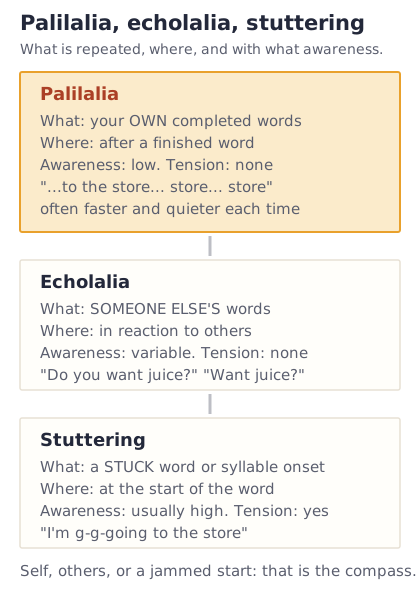
| What is repeated | Position | Awareness / tension | |
|---|---|---|---|
| Palilalia | Your own completed words | After a finished word | Low / no tension |
| Echolalia | Someone else's words | In reaction to others | Variable / no tension |
| Stuttering | A stuck word or syllable onset | Word onset | Usually high / tension present |
In short: palilalia repeats the self, echolalia repeats others, and stuttering jams at the beginning of words with visible effort. Palilalia is typically acquired and neurogenic, whereas developmental stuttering has a very different profile.
In session: what actually helps
The evidence base is thin and old, mostly single-case reports rather than controlled trials, and no speech technique treats the underlying disease. But the approaches converge on rate control and external pacing, and several are worth knowing.
1. Pacing board. The foundational reference is Helm (1979), "Management of palilalia with a pacing board." The patient taps one segment per word, moving automatic speech under conscious, voluntary control (a Luria-inspired principle). It segments and slows even severe palilalic output.
2. Delayed auditory feedback (DAF). Hanson and Metter (1980) used DAF to slow rate and support loudness in palilalia. Use it with care: in some neurogenic speakers DAF can increase errors, so it is a per-patient trial, not a default.
3. Rate-control techniques. Rhythmic or metronomic pacing, deliberate pausing cues, and visual counters are widely treated as the first-line approach.
4. Self-monitoring. Because awareness is often low, making the repetition perceptible is central: recording and playback, real-time feedback, and a "stop, then restart once" strategy help turn automatic speech into monitored speech.
5. Loud, effortful voice (Parkinson's context). Intensive loudness programs such as LSVT LOUD improve loudness, intonation, and, as a distributed effect, rate. No study has directly measured LSVT's effect on palilalia specifically, so treat it as a plausible adjunct, not evidence-based fact.
6. Treat the cause. In Parkinson's disease, palilalia fluctuates with dopaminergic state, so coordinate with the neurologist.
Try Helm's pacing board: one square per word, your tap sets the pace, and the counter shows the average interval between two words.
Where Talk Slower fits (and where it does not)
Let us be honest. Palilalia is a neurogenic symptom: the app does not treat the cause and does not replace a physician or a speech-language pathologist. It is not a medical device, and its measures are indicative.
What it does well overlaps precisely with the rate-control and self-monitoring levers above. Talk Slower gives objective rate tracking in SPS (syllables per second) across reading and spontaneous speech, real-time biofeedback to support self-monitoring, structured slowing practice, and short daily sessions between clinical appointments. For someone already working with a clinician, it is a way to rehearse the monitoring of one's own speech, day to day. A support, not a cure.
FAQ - your questions about palilalia
Is palilalia serious?
Palilalia is a symptom rather than a disease. What matters is the cause, which is often neurological (Parkinson's disease, stroke, and others). The right step is a medical assessment of that underlying context rather than alarm about the symptom alone.
What is the difference between palilalia and echolalia?
Palilalia is repeating your own words; echolalia is repeating other people's words. Both are involuntary, but the source differs.
Is palilalia a form of stuttering?
No. Stuttering jams at the onset of words with visible tension and usually high awareness. Palilalia repeats an already finished word, without struggle and often without the speaker noticing.
Can palilalia be treated with exercises?
Exercises manage the symptom rather than cure it, since the cause is treated first. Rate control, pacing (one tap per word), loud clear speech, and self-monitoring can help regain control of the repetitions, ideally with a speech-language pathologist.
How is speech rate measured?
Talk Slower uses SPS (syllables per second). Articulation rate excludes pauses longer than about 250 milliseconds, so you can see the true speed of the speech itself, which is useful for spotting festination.
Key takeaways
Further reading: echodysphemia and word-final disfluencies and what cluttering is.
General information only: it does not replace the advice of a speech-language pathologist or a doctor. Talk Slower is not a medical device.
Updated August 16, 2026

I built Talk Slower after my own cluttering therapy. I wanted to create the tool my speech-language pathologist would have prescribed if it had existed: objective SPS measurement, at-home exercises, remote tracking. The app keeps evolving by staying close to speech-language pathologists.