"Slow down." "Wait, say that again?" "You talk so fast!" If you have heard these all your life, you have probably wondered at some point whether something is wrong with you.
Most of the time, nothing is. Talking fast is very common, and for most people it is simply how they are wired. But "why do I talk so fast?" has more than one answer, and the answer matters: a habit, a case of nerves and a speech disorder do not call for the same fix.
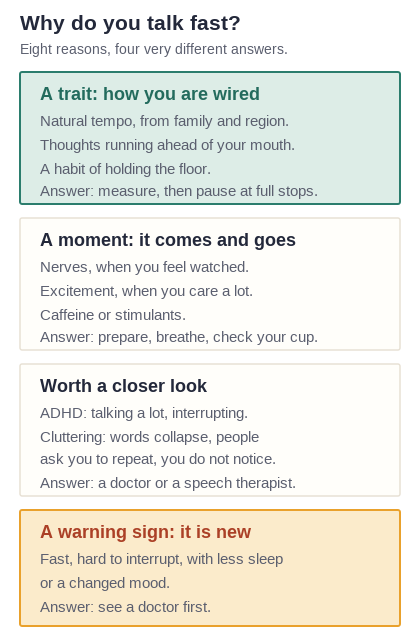
In short: people talk fast for eight common reasons: natural tempo, a brain that runs ahead of the mouth, nerves, excitement, fear of losing the floor, caffeine or stimulants, ADHD, and cluttering. The first six are traits or moments, not disorders. Cluttering is a speech disorder worth assessing. And fast speech that is new, with changes in sleep or mood, is a medical question first.
The real question behind "why do I talk so fast?"
When people type this question, they are rarely asking for a list. They are asking: is this just me, or is it a problem?
Here is the honest answer. Speed on its own is not a problem. Plenty of people talk fast and are perfectly easy to follow. Fast talking becomes a problem when it costs you something: people keep asking you to repeat, you lose them halfway through a story, or your words start running into each other.
So as you read the eight reasons below, keep one question in mind: can people follow me comfortably? That question will tell you more than any number.
8 reasons people talk fast
1. It is simply your natural tempo
Everyone has a default speed, the way everyone has a default walking pace. Speaking rate varies with age, sex and even region: a well-known study of American English (Jacewicz and colleagues, 2009) found speakers from the North faster than speakers from the South, men slightly faster than women, and younger adults faster than older ones. Families pass on a tempo too. If everyone at your childhood dinner table spoke quickly, you learned to as well.
This is not a disorder. It is a setting.
2. Your thoughts run ahead of your mouth
Many fast talkers describe the same feeling: the next idea is already there before the current sentence is finished, and the mouth sprints to catch up. Your brain is busy planning, and it has little attention left to monitor the speed of what is coming out.
That is also why most fast talkers genuinely cannot hear their own speed. It is not a lack of effort. In the moment, the signal does not reach you. (Yes, even when someone has just told you to slow down.)
3. Nerves
Anxiety speeds speech up and strips out pauses. When you feel watched, in a meeting, on a call, in front of a class, speaking fast becomes an escape hatch: the sooner the words are out, the sooner it is over. Many people who are calm and steady with friends speed up only under pressure.
4. Excitement
The flip side of nerves. When you care about what you are saying, your enthusiasm sets the pace. A great story, a passion, good news: the words tumble out because you want them out.
5. Fear of losing the floor
If you grew up in a big, loud family, or you work somewhere conversations are a competition, you may have learned that pausing means being interrupted. So you stop pausing. Speed becomes a way of holding on to your turn.
6. Caffeine and stimulants
A strong coffee, an energy drink, some medications and recreational stimulants can all push your rate up. If you notice you talk faster on certain days, look at what is in your cup before looking anywhere else.
7. ADHD
People with ADHD often talk a lot, interrupt, jump between ideas and find it hard to wait their turn. Talking excessively is one of the hyperactivity-impulsivity signs listed in the DSM-5-TR. Fast talking itself is not a criterion, and it is certainly not proof of ADHD: plenty of fast talkers do not have it. But the two often travel together, and ADHD is also frequently reported alongside cluttering (next point).
8. Cluttering
This is the one reason on the list that is a speech disorder. Cluttering is speech that comes out too fast, too irregular, or both, to the point that syllables collapse, word endings disappear and sentences restart. Researchers such as St. Louis and Schulte, and van Zaalen and Reichel, describe it as a problem of rate combined with low awareness of how you sound to listeners.
I know this one from the inside: I have cluttered since childhood. For years I thought I just "talked fast". What I did not know was that my listeners were losing whole words.
When fast talking is a symptom, not a trait
Everything above is about how you have always talked. There is one situation where the rules change: when fast talking is new.
If speech has become fast and hard to interrupt over days or weeks, especially alongside much less sleep, an unusually high or irritable mood, racing thoughts or risky decisions, that is not a habit to train. It can be what clinicians call pressured speech, and it is a medical question first. An overactive thyroid and stimulants can cause it too. In that case, see a doctor rather than a speech exercise.
Pause: talking fast is not a disorder
Let me be clear, because this matters. If you have always talked fast, people can mostly follow you, and your sleep and mood are as usual, you are a fast talker. Not a patient.
Fast talkers are often lively, warm, quick-thinking people. The goal is never to turn you into someone else. The goal, if your speed costs you something, is to give you a brake you can use when you need it.
Seven questions to see which of the reasons above fits you best, and what to do about it.
Do smart people talk faster?
It is a popular idea, and a flattering one. There is no good evidence that speaking rate tells you anything about intelligence. Fast talkers can be brilliant, and so can slow ones. What fast talkers do often share is a busy mind and a lot to say, which is a different thing.
So what do I actually do?
It depends on your reason, but the first step is the same for everyone.
1. Measure instead of guessing. Since nobody hears their own speed accurately, start with a number. The free voice test gives your rate in syllables per second in about two minutes. Typical conversational English sits around 4 to 5 syllables per second; above roughly 5.5, listeners start to struggle. The speaking rate norms explain the details.
2. Use pauses, not willpower. You cannot reliably decide to slow down mid-sentence. You can decide to stop at the end of the next one. I call it the full-stop pause: every time you reach a full stop, breathe in before the next sentence. It sounds tiny. It changes everything for the listener. The full method is in How to talk slower.
3. Match the fix to the reason.
Measure a speech rate in 2 minutes.
You read, then you talk. Free, no sign-up.
Test my speech rate for freeWhen to see a speech-language pathologist
Book an assessment if people regularly ask you to repeat, if your words run together or drop syllables, if your rate is irregular (bursts, then stops), or if your speed is hurting you at work or socially. That pattern looks more like cluttering than a simple fast tempo, and it responds well to targeted work. Not sure? Cluttering vs stuttering and what is cluttering will help you decide.
FAQ - your questions about talking fast
Why do I naturally talk so fast?
Usually because it is your natural tempo, shaped by temperament, family and region, and because your thoughts run ahead of your mouth. Most fast talkers cannot hear their own speed, which is why "just slow down" rarely works.
Is talking fast an ADHD thing?
Not necessarily. Talking excessively and interrupting are listed among ADHD signs, and many people with ADHD do talk fast, but fast talking alone is not a sign of ADHD. Plenty of fast talkers do not have it. If you recognise other ADHD signs in your daily life, talk to a doctor.
What does it mean if you speak fast?
On its own, very little. It can reflect your natural tempo, nerves, excitement or caffeine. It is worth a closer look if people often cannot follow you, if your words run together, or if the speed is new and comes with changes in sleep or mood.
Do high IQ people talk fast?
There is no good evidence that speaking rate reflects intelligence. Fast talkers often have a busy mind and a lot to say, but slow, careful speakers can be just as sharp.
Is talking fast a sign of anxiety?
It can be. Anxiety speeds speech up and removes pauses, and many people only speed up under pressure. But many fast talkers are not anxious at all: it is simply how they talk.
Can I train myself to talk slower?
Yes. Measuring your rate, then practising pauses at sentence boundaries, works far better than trying to "slow down" in general. Seeing your rate live while you speak makes the change stick.
Key takeaways
Talking fast is usually a trait, not a disorder. Natural tempo, a busy mind, nerves and excitement explain most of it.
The useful question is not "how fast am I?" but "can people follow me?"
Cluttering is the speech disorder on the list: fast or irregular speech, collapsing words, low awareness. A speech-language pathologist can help.
New, hard-to-interrupt fast speech with changes in sleep or mood is a medical question first.
And whatever your reason: measure first, then pause at full stops.
This article is general information, not medical advice. If your speech has changed recently, or you are worried about someone, speak to a doctor.
General information only: it does not replace the advice of a speech-language pathologist or a doctor. Talk Slower is not a medical device.
Updated November 9, 2026
Sources

I cluttered all my life without knowing it. In 2022, a speech-language pathologist who specializes in fluency helped me understand and work on my speech rate. That journey is what led me to build Talk Slower, the tool I wish I'd had from the start.