You have read that cluttering is "rapid and irregular speech with reduced intelligibility". Fine. But what does that actually sound like? Would you recognise it in a friend, a child, or in yourself?
That is the gap this article fills. Below are six examples of cluttered speech, each showing one feature, with what to listen for.
In short: cluttering sounds like speech that is too fast, too irregular, or both: long words collapse ("probly", "statically" for statistically), speech comes in bursts with pauses in odd places, sentences turn into mazes of restarts, and the speaker usually does not notice. When the same person slows down, the speech becomes clear. That last point is the giveaway.
About the examples: they are written illustrations built from the features described in the clinical literature (St. Louis and Schulte; van Zaalen and Reichel). They are not recordings of real people. Real cluttering mixes several features at once.
Example 1: words that collapse
"We're gonna look at the statically signif'cant results, probly next week, partic'ly the nuclar part."
What to listen for: syllables disappear inside long words. Statistically becomes "statically", probably becomes "probly", particularly becomes "partic'ly". Clinicians call this telescoping: the word folds in on itself because the mouth is moving faster than it can articulate every syllable.
This is the most typical sound of cluttering, and the one listeners notice first, often without knowing why. They just feel they "missed a word".
Example 2: bursts, then a stop
"SoIwenttothebankyesterdayand ... they said ... IneededanotherformbutIhadalreadybroughtit."
What to listen for: the rate is not just fast, it is irregular. A rush of words with no gaps, a sudden stop, then another rush. The words run together inside each burst, which is why listeners lose the thread even when every word is technically there.
This is also why a single average speed can look almost normal in someone who clutters. The problem is in the bursts, not the average.
Example 3: the maze
"I was, um, the thing is, when we, so my boss, he wanted, no, she wanted the report by, like, Friday? Or, no, it was the other one."
What to listen for: many revisions, restarts and fillers ("um", "like", "the thing is"). The speaker starts a sentence, changes direction, starts again. These are the "normal" kind of disfluencies everyone has, but far more of them.
Van Zaalen and Reichel distinguish two faces of cluttering: one where the sounds and syllables collapse (examples 1 and 2), and one where the sentences get tangled because language planning cannot keep up with the speed (this example). Many people show a bit of both.
Example 4: pauses in the wrong places
"Could I have a | cup of coffee and a | piece of the | chocolate cake please."
What to listen for: pauses happen, but not where the meaning breaks. They fall in the middle of phrases ("a | cup"), while the natural boundaries ("coffee and | a piece") are rushed through. The listener has to rebuild the sentence structure themselves.
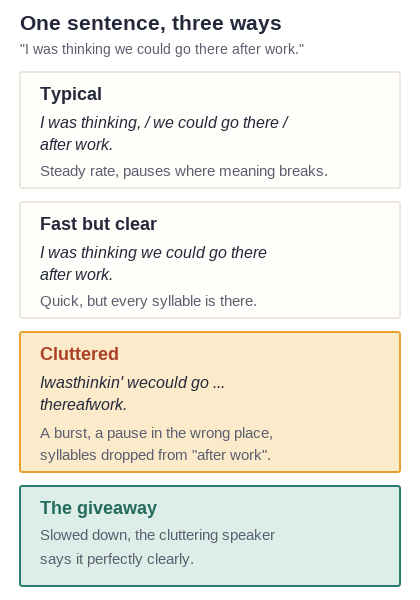
Example 5: "Sorry, what?"
Speaker: "Iwasthinkingwecouldgothereafterworkifyou'refree."
Listener: "Sorry, what?"
Speaker (clearly, slowly): "I was thinking we could go there after work, if you're free."
What to listen for: the second version is perfectly clear. This is the most important feature of all. Cluttering is not a difficulty producing sounds: when the person slows down or pays attention, the speech becomes clean. It is a problem of rate and self-monitoring.
And the speaker is often surprised to be asked to repeat. Most people who clutter cannot hear their own speed. (I am one of them: I have cluttered since childhood, and "sorry, what?" was the soundtrack of my teenage years.)
Example 6: dropped word endings
"I wan' to fin' the res' of the tex' befo' we lea'."
What to listen for: final consonants are clipped, especially in clusters (want to, find, rest, text). Everyone does a little of this in casual speech. In cluttering it happens constantly, and combined with speed, it costs intelligibility.
Quick reference: features and what you hear
Swipe the table to see every column
| Feature | What you hear | Example |
|---|---|---|
| Telescoping | Syllables dropped inside long words | "statically" for statistically |
| Irregular rate | Bursts with no gaps, then stops | "SoIwenttothebank... they said..." |
| Mazes | Many restarts, revisions, fillers | "he wanted, no, she wanted..." |
| Odd pauses | Pauses mid-phrase, none at boundaries | "a ... cup of coffee and a ... piece" |
| Clipped endings | Final consonants dropped | "I wan' to fin'..." |
| Low awareness | Surprised to be asked to repeat | "Sorry, what?" |
| Clear when slowed | Same sentence, perfectly intelligible | The key to the diagnosis |
Your turn: six short lines, one feature each. Can you spot which one?
What cluttering is not
It is not stuttering. In stuttering, the person knows exactly what they want to say and gets stuck: a block (silent, tense), a prolongation ("sssssorry"), or a repetition of the first sound ("b-b-but"). There is usually physical tension and strong awareness. In cluttering, there is little tension, little awareness, and the speech runs away rather than getting stuck. The two can occur together, which is why a speech-language pathologist's assessment matters. Cluttering vs stuttering goes into the details.
It is not just talking fast. A fast talker who is easy to follow does not clutter. Cluttering is about speed that outruns articulation or language, not speed alone. Some people even clutter at a fairly ordinary average rate, because their rate is irregular. If you are a fast but clear talker, why do I talk so fast? is the article for you.
It is not an articulation disorder. Someone with an articulation disorder mispronounces a sound every time, at any speed. Someone who clutters says it correctly when they slow down.
Pause: recognising yourself is good news
If you have read the examples and thought "that's me", take a breath. Cluttering is not a sign that something is wrong with your intelligence, and it is not rare: estimates suggest around 1% of people, with many never diagnosed.
It also responds well to work. Because the speech becomes clear when the rate is controlled, the whole job is learning to notice and manage your rate. That is very learnable, especially with feedback you can see.
So what do I actually do?
Measure a speech rate in 2 minutes.
You read, then you talk. Free, no sign-up.
Test my speech rate for freeFAQ - your questions about cluttered speech
What does cluttering sound like?
Fast and/or irregular speech in which long words collapse ("probly", "statically"), words run together in bursts, pauses fall in odd places, and sentences restart. Listeners often feel they missed a word. When the speaker slows down, the speech becomes clear.
Is cluttering the same as talking fast?
No. Plenty of people talk fast and are easy to follow. Cluttering means the speed outruns the person's ability to articulate or organise what they say, so intelligibility drops. Some people clutter at an ordinary average rate because their rate is very irregular.
Can you hear cluttering in children?
Cluttering is often noticed from late childhood or adolescence, when language becomes more complex. In young children, fast and messy speech is common and usually normal, so an assessment by a speech-language pathologist is the way to tell the difference.
Is cluttering a sign of ADHD or autism?
Not on its own. Cluttering is frequently reported alongside ADHD, and it is also described in some autistic people, but it occurs in people with neither. If you suspect ADHD or autism, that is a separate assessment.
How do you fix cluttering speech?
With a speech-language pathologist, by building awareness of your own rate and learning to manage it: pausing at phrase boundaries, slowing on long words, and practising with feedback you can see or hear. Because the speech is clear when slowed, progress is usually good with regular practice.
Key takeaways
Cluttering sounds like speed outrunning the mouth: collapsing words, bursts, mazes, odd pauses.
The giveaway is that the speech is clear when slowed down. That separates it from articulation disorders.
It is not stuttering and not simply talking fast, though it can occur alongside stuttering.
Most people who clutter cannot hear it themselves, so measuring your rate and asking others is the best first step.
This article is general information, not medical advice. Only a speech-language pathologist can assess cluttering.
General information only: it does not replace the advice of a speech-language pathologist or a doctor. Talk Slower is not a medical device.
Updated November 9, 2026
Sources

I cluttered all my life without knowing it. In 2022, a speech-language pathologist who specializes in fluency helped me understand and work on my speech rate. That journey is what led me to build Talk Slower, the tool I wish I'd had from the start.