You caught it while your child was telling you about their day. At the end of some words, a small echo comes back: "we went to the park... park", "I saw a cat-cat". They do not seem to notice. And you are left wondering whether it is normal, whether it is stuttering, and whether you should worry.
In short: the echo lands at the end of words, with no effort and no struggle - which is exactly what separates it from stuttering. Your child does not notice it and is not bothered by it. It usually fades on its own, and the single most useful thing you can do is not point it out.
Good news: this pattern has a name, it is recognized, and in the large majority of cases it is quiet and temporary. Here is what to know. For the clinical detail, our companion article covers echodysphemia and word-final disfluencies.
It has a name: echodysphemia (word-final disfluency)
Echodysphemia is a discreet fluency pattern in which a repetition attaches to the ends of words. In English clinical work it is usually called word-final disfluency or end-word disfluency.
It shows up in two main forms:
A close cousin, broken words, is a little break in the airflow inside a word ("magni_ficent"), without the vowel coming back.
Three reassuring things to know right away:
Is it stuttering? No, and here is why
This is the most common worry, and the difference matters.
Swipe the table to see every column
| Where? | Visible effort? | Does the child notice? | |
|---|---|---|---|
| Word-final disfluency | At the end of words | No | Usually no |
| Stuttering | At the start of words | Yes (block, struggle) | Often yes |
Stuttering jams and pushes at the beginning of words, with tension you can see and hear. Word-final disfluency adds a calm little echo at the end, with no effort. It is also not echolalia, which is repeating other people's words (for example repeating a question instead of answering it).
Why does it happen?
The research is still young and careful here. What we observe:
In other words: word-final repetition on its own is not a diagnosis. It is an observation, sometimes isolated and harmless, sometimes one piece of a larger picture.
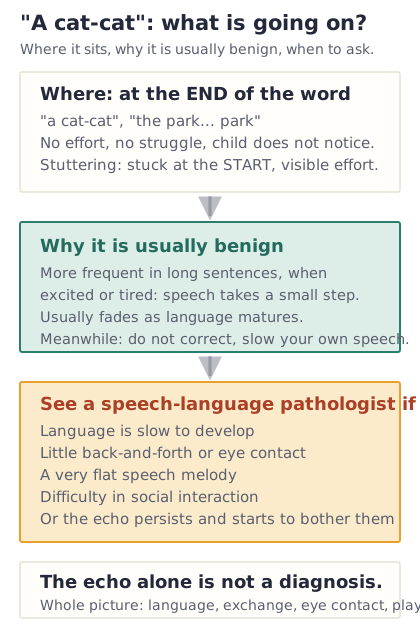
Should you worry? The honest answer
In most cases, no. If your child is doing well otherwise, communicating, playing, and connecting with you, and these small repetitions are the only thing that catches your attention, it is most often a passing pattern to simply keep an eye on.
It is worth talking to a speech-language pathologist if, alongside the word-final echo, you notice other signs: language that is slow to develop, little back-and-forth or eye contact, a very flat speech melody, or difficulty in social interaction. In that case, it is not the word endings that get treated first. A professional will calmly assess the whole picture.
So what do I actually do? (and what not to do)
A natural reflex is to correct: "say it properly", "stop doubling the ending". That is exactly what to avoid.
Because your child is not aware of these repetitions and is not suffering from them, constantly pointing them out risks creating worry where there was none, or even installing a new habit to compensate. Specialists in these atypical disfluencies (such as Vivian Sisskin in the United States) stress this: good support makes the repetition fade without replacing it with something else.
What helps instead:
Try it: sort six short examples and see what to note for the speech-language pathologist.
And where does Talk Slower fit?
Let us be transparent. For a young child whose word-final disfluency is discreet and probably temporary, our app is not the first thing to reach for. Listening, time, and, if needed, a speech-language pathologist matter far more.
Talk Slower (training rate, self-listening, and prosody) makes sense later, for an older child or teenager where these repetitions persist and become bothersome, and always alongside professional support. It is not a medical device, and it does not diagnose anything.
FAQ - your questions about word-final repetitions
My child repeats the ends of words, is it serious?
Most often, no. Echodysphemia is a discreet pattern, without effort or distress for the child, and it frequently fades on its own. What matters is the overall picture: if they communicate and develop well otherwise, the main thing is to observe.
Echodysphemia or stuttering, how do I tell?
Stuttering affects the start of words, with visible effort and tension, and the child is often aware of it. Word-final disfluency adds an echo at the end of words, without effort, and the child usually does not notice.
At what age does it go away?
There is no exact age, but these repetitions tend to decrease clearly as language consolidates, often before adolescence. A speech-language pathologist can track it if needed.
Should we see a speech-language pathologist?
Not necessarily for word-final disfluency alone if it is isolated. Yes, if it comes with other signs (language, communication, interaction) or if it persists and bothers the child as they grow.
Is it a sign of autism?
Not on its own. These repetitions are more common in children with a neurodevelopmental condition, but they also occur without any diagnosis. Only a full developmental assessment can answer that question.
Key takeaways
Further reading: echodysphemia and word-final disfluencies (clinical), palilalia, and - if it is the shortness of your child's sentences that worries you rather than the repetitions - telegraphic speech.
General information only: it does not replace the advice of a speech-language pathologist or a doctor. Talk Slower is not a medical device.
Updated August 16, 2026

I built Talk Slower after my own speech therapy.